
Uncategorized
Portable vs Under-Tray Water Tanks for Trucks and Work Vehicles
Oct
The right water storage tank can make or break a workday, yet most ute and truck owners treat the decision as an afterthought until capacity runs short or a poorly secured tank shifts load mid-corner. If you are comparing configurations, our water tanks range is a good place to start. Whether you are outfitting a service ute, a long-range touring build or a mixed-use fleet, the choice between portable and permanently mounted under-tray tanks carries real consequences for payload, install complexity and day-to-day workflow.
This guide works through the trade-offs that matter in an Australian context: capacity in litres, what a full tank actually weighs, the material specifications that decide whether a tank survives our sun, the standards behind a “food grade” or potable claim, and the mounting hardware each approach demands. By the end you will have a practical framework for matching a tank to your vehicle and application without overbuilding.
Portable vs Permanent: The Core Trade-Off
The market for ute and work vehicle water storage divides into three functionally distinct categories, and the right choice depends entirely on how water moves within a specific operation.
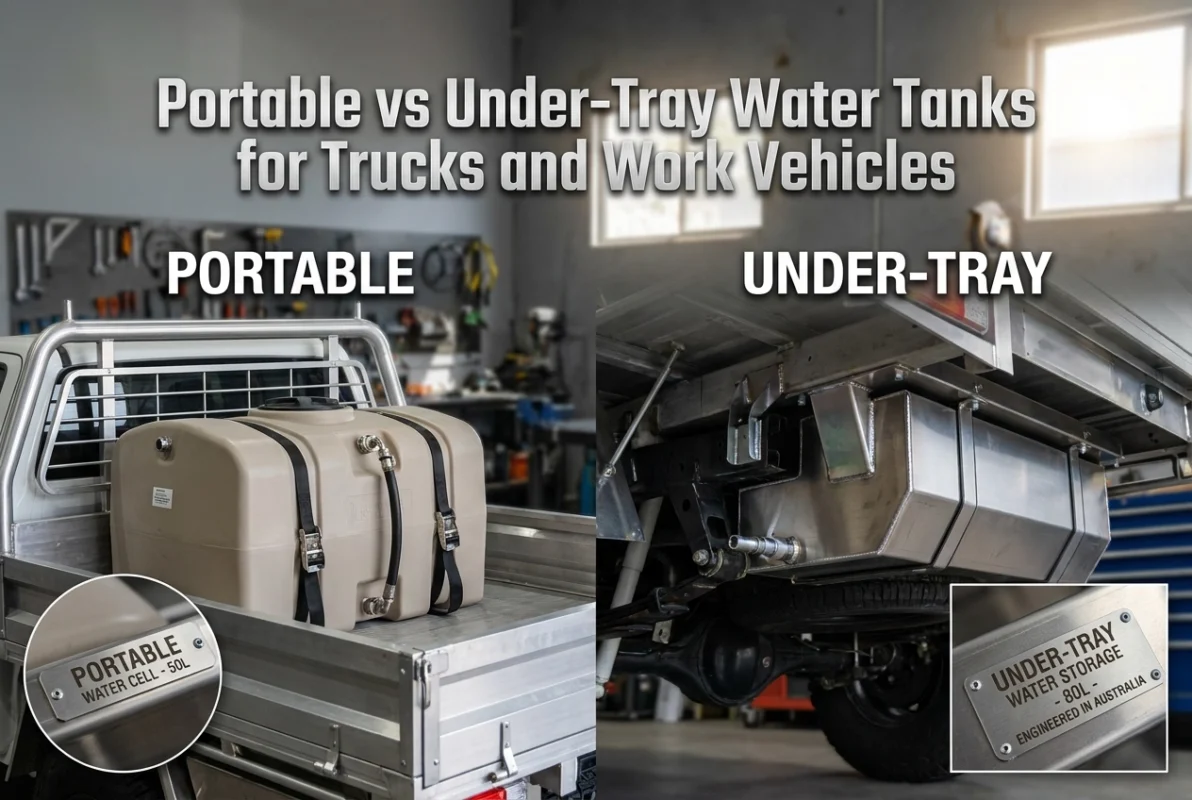
Portable (transportable) tanks are designed to move with the load, not the vehicle. A contractor running the same tank across multiple vehicles, or lifting it off one rig to deploy on a jobsite, needs a unit that transfers cleanly between platforms. Portability is the feature; lower maximum capacity is the trade-off.
Permanent under-tray or tray-mounted tanks are fixed to the vehicle as part of its fit-out. Because they are not removed between jobs, they can be larger, plumbed properly and integrated with pump and hose reel systems. The install is cleaner, the capacity ceiling is higher, and the load deck stays free for tools and materials.
Temporary storage options, including bladder tanks and folding frame tanks, occupy a growing third category. These are neither portable tanks in the conventional sense nor permanent installations. They collapse when empty, deploy when needed and leave the vehicle unmodified. Tourers managing weight on extended trips and crews rotating vehicles between water-carrying and non-water roles are driving adoption of this format. The convenience comes with limits: finite cycle life, puncture vulnerability on active worksites, and lower sustained-use practicality compared to a fixed polyethylene tank.
The decision is not a ranking exercise. A landscaper running a dedicated spray rig five days a week has a different problem from a tourer who needs water on one trip in three. Portable tanks solve a fleet logistics problem. Permanent tanks solve a dedicated-vehicle fit-out problem. Temporary tanks solve a no-modification, variable-deployment problem. Identifying which problem applies to your workflow is the starting point for every specification decision that follows.
Capacities in Litres: What the Numbers Actually Mean
Once the category is selected, capacity becomes the next hard constraint, and Australian ute tray and under-tray tanks are sold by capacity in litres. The sizes you will see most often for tray applications run from around 20L through 25L, 40L, 45L, 50L, 60L, 65L, 80L, 100L and 125L, up to roughly 200L for larger units.
Tray-mounted tanks are constrained by two things, not one. The first is the physical envelope under the tray or behind the cab, and the second is how much weight you can legally and safely add to the vehicle. A tank that fits the space but exceeds your payload margin is not a usable specification.
Low-profile designs are not a cosmetic choice. They are shaped to keep the centre of gravity low, which directly affects vehicle stability when the tank is partially full and the load is sloshing. They also preserve rear visibility. Specifying a tall tank where a low-profile variant exists should be a deliberate decision, not a default.
Flat-top and space-saver variants take that geometry further. The flat top surface can be used as a mounting platform for pumps, hose reels or auxiliary equipment, effectively turning the tank from a passive water carrier into part of the working deck — which matters on a crowded tray where every surface is competing for use.
Payload: One Litre of Water Weighs One Kilogram
The arithmetic here is simple and unforgiving: water weighs about 1 kg per litre. A full 100L tank adds roughly 100 kg, a 200L tank roughly 200 kg — and that is before you count the tank body itself, mounting brackets, pump, hose, and any water sitting in the lines.
Run that sum against your vehicle’s payload before you shortlist a capacity. Subtract the tank and its full contents, the driver, passengers and all other cargo from the vehicle’s rated payload, and see what margin is left. Capacity selection has to start with the available payload margin, not with the largest tank the tray will physically take.
Permanent under-tray installs offer a modest but real advantage over a portable setup: the lower centre of gravity improves stability at high fill levels, and the fixed install removes the weight of straps, cradles and tie-down hardware. Portable tanks offer a different kind of flexibility — leaving the tank at home on non-water days restores the full rated payload for other cargo. Confirm the payload and load restraint requirements that apply to your vehicle and state before operating a loaded tank on public roads.
Materials: Polyethylene, Steel and Flexible Options
Capacity determines whether a tank fits your workflow; material determines whether it survives it.
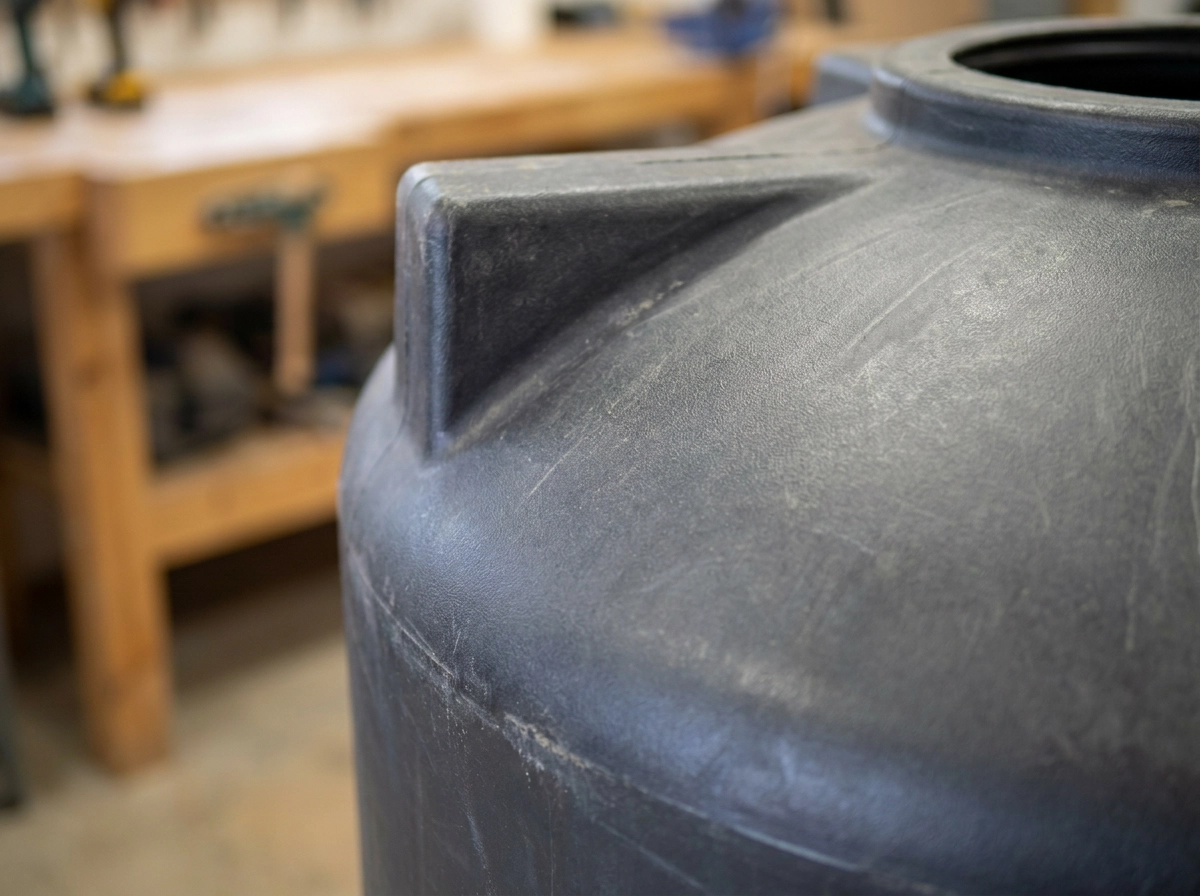
Polyethylene is the dominant choice for tray and under-tray water storage. Rotationally moulded polyethylene is light relative to its capacity, corrosion resistant, and can be formed into the low-profile, contoured shapes that suit vehicle profiles without wasting space.
What “Food Grade” and “Potable” Actually Mean in Australia
Not all polyethylene tanks are equivalent, and this is where buyers most often assume rather than verify. If water is intended for drinking, stock watering or spray on edible crops, the material has to be rated for contact with drinking water. In Australia, three standards do the work:
- AS/NZS 4020 covers the suitability of products in contact with drinking water, testing them by exposure to extractant waters to confirm they do not leach harmful substances into stored water.
- AS 2070 covers plastics intended for food contact, including plastic water tanks, so the material does not contaminate what it holds.
- AS/NZS 4766 sets requirements for the design and manufacture of rotationally moulded, one-piece seamless polyethylene storage tanks for non-buried, vertical installation, containing water at atmospheric pressure.
A tank marketed as food grade or potable should be able to back that claim with a compliance marking on or with the tank, manufacturer certification, and third-party test documentation. If the application involves water people or livestock will consume, ask for that evidence rather than relying on the product listing.
UV stabilisation is a separate specification from potable rating, and both matter for exposed installs. Polyethylene degrades under prolonged UV exposure, becoming brittle and prone to surface cracking, and Australian sun is hard on anything mounted under a tray or in an open bed. Stabilisation comes from additives such as UV absorbers and hindered amine light stabilisers blended into the compound during moulding, and suppliers of properly stabilised tanks claim outdoor service life of 20 years or more. Some reference UV8 or higher. For any installation that sees direct sun, confirm UV stabilisation is part of the product specification, not an assumption.
Steel tanks suit applications needing high-pressure performance or tolerance of extreme temperatures, such as pressurised spray systems or heavy industrial use. The trade-off is weight per litre of capacity, plus the need for internal lining or surface treatment to resist corrosion — and that lining needs periodic inspection and eventual re-application.
Bladder and flexible tanks solve a problem rigid tanks cannot: dead weight when empty. Made from reinforced PVC or similar material, they collapse flat when not in use, which makes them practical for tourers or crews who need capacity on some trips but not others. They are not a high-cycle substitute for a permanent installation, but for intermittent use the packability advantage is genuine.
Under-Tray Mounting: Hardware and Installation Considerations
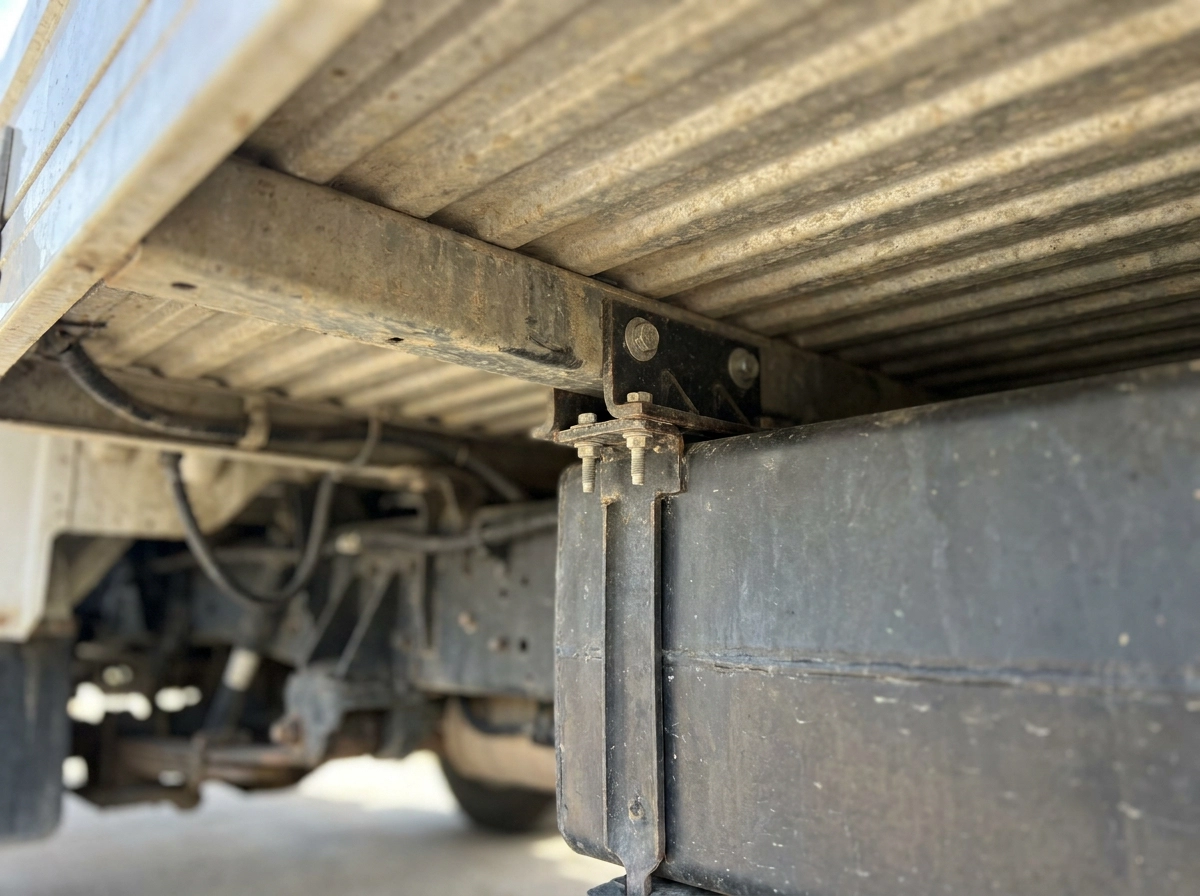
With material selected, the next decision is how the tank physically integrates with the vehicle. Under-tray mounting raises the hardware requirements considerably compared with setting a tank in the tray.
Position and load path. Mounting a tank below the tray floor or behind the cab keeps the deck clear and drops the centre of gravity. The trade-off is that the tank is now suspended from the chassis or subframe, which puts every bracket, fastener and support member in the load path between the tank and the road. Road vibration, braking loads and rough terrain multiply the static weight that hardware has to handle, so brackets and fasteners must be sized for dynamic load, not just the filled weight at rest.
Mounting provisions and hardware matching. Tanks with moulded mounting feet, pre-formed flanges or integrated bracket points simplify alignment during installation, but they do not remove the need for careful hardware selection. The brackets still have to match the tank geometry, the available chassis mounting points and the anticipated load conditions. Undersized fasteners, or a single mounting plane without cross-bracing, introduce flex that stresses both the tank and the vehicle structure over time.
Plumbing penetrations and sealing. Outlet fittings on Australian tanks are commonly 25 mm (1 inch), and larger tanks use inlet openings in the 200–500 mm range to take a strainer and cover — so confirm the actual fitting sizes on the specific tank before you plan plumbing runs. Where fittings pass through the tray floor or a cab-end panel, the hardware needs to account for vibration-induced movement and moisture ingress. Rubber grommets, compression seals and vibration-resistant fittings stop the cyclic flex of the tray from working loose what would otherwise be a sound connection.
Offset fill openings and access clearance. Offset fill designs let you fill without climbing into the tray, which is a safety feature built into the tank geometry itself. Plan the mounting position to preserve that clearance; boxing the fill point behind a structural member throws the benefit away.
Enclosure hardware. For fabricators building a custom under-tray enclosure or subframe, the hardware families are the same as those used in toolbox and drawer builds: hinges for access panels, compression latches to hold lids closed under vibration, rubber seals to keep dust and water out of the cavity, and drawer slides where the enclosure carries a sliding unit. Specifying that hardware alongside the tank, rather than retrofitting it later, produces a cleaner and more serviceable result. We supply these components for under-tray and ute tray applications.
Securing a Portable Tank in the Tray
A permanent under-tray install solves the securing problem by design. A portable tank in the tray does not: it is only as secure as whatever is holding it in place, and a full tank in motion under hard braking or in a sharp corner does not stop when the vehicle does.
Tray-floor tie-down points used with ratchet straps are the baseline. They work, but they are operator-dependent: inconsistent strap tension, worn webbing and poor strap angles are common failure points. If you run a portable tank regularly, a purpose-built cradle or cross-beam support frame bolted through the tray floor is the more reliable solution, giving a fixed, repeatable mounting position that does not depend on someone re-tensioning straps correctly at every site.
Before buying, check the specification for moulded recesses or integrated tie-down lugs. These let straps seat cleanly against the tank body instead of riding up on curved sidewalls, which reduces strap wear and the risk of slipping under load. Not every portable tank includes them.
Position portable tanks as far forward and as low in the tray as practical. Forward placement reduces the lever-arm effect on rear axle loading; low placement keeps the centre of gravity close to the tray floor. And remember that load restraint obligations apply to a tank exactly as they apply to any other cargo — a “portable” label is not an exemption.
Use-Case Breakdown: Tradies, Tourers and Fleet Operators
Payload constraints set the upper bound; application decides the right configuration within it.
Tradies and contractors in landscaping, concreting, dust suppression and firefighting support are the clearest case for a permanent install. The vehicle is a dedicated work platform, the tank is part of the fit-out, and capacity is matched to daily water demand. A removable tank adds handling and re-securing on every job.
Tourers and remote-area travellers work from the opposite priorities. Flexibility and weight management matter more than raw volume, so portable or collapsible tanks sized to the trip are the sensible choice. A large permanent tank adds dead weight on every trip, most of it never needed, while recovery gear and supplies compete for the same payload.
Agricultural and rural operators face a specification question that goes beyond size. Stock watering calls for a tank that genuinely meets potable water requirements, and spray applications using herbicides or fertilisers need a chemical-rated material. Using an uncertified tank in either role is not just a performance issue — it creates compliance and liability exposure, so confirm the material rating before selecting.
Fleet operators gain the most from standardisation. Consistent mounting provisions and matching fitting sizes across the fleet simplify cross-vehicle maintenance and parts management. A single approved tank platform is easier to manage than a collection of one-off installs.
Selecting the Right Tank: A Practical Framework
Step 1: Answer the water movement question first. Portable, permanent or temporary — this decision logic comes before any specification detail.
Step 2: Calculate your payload budget. Take the vehicle’s rated payload, subtract the driver, passengers and all non-water cargo, then subtract the tank body and its contents at 1 kg per litre. Whatever is left is your real constraint.
Step 3: Match capacity to payload, not to tray space. Work backwards from the payload figure to a litre capacity, then check whether a capable low-profile or flat-top variant exists in that size.
Step 4: Verify material specifications against the application. For exposed installs, confirm UV stabilisation in the compound. For drinking or stock water, confirm the tank carries a potable rating supported by compliance marking and test documentation under AS/NZS 4020 and AS 2070. For spray use, confirm the chemical resistance rating covers the products you actually use. Check the product data sheet, not just the listing.
Step 5: Plan mounting hardware before finalising the tank. An under-tray install involves brackets, fasteners, plumbing penetrations and access panel hardware, and treating those as an afterthought adds cost and rework. Aligning the tank mounting with the rest of the build — enclosure hinges, compression latches, seals and slides — gives a more integrated result than specifying each element independently.
Maintenance, Longevity and Total Cost of Ownership
Polyethylene tanks are the lowest-maintenance option. The routine task is periodic flushing to clear sediment. In potable applications, stagnation accelerates bacterial growth, so a tank that has sat unused for a long period should be drained, flushed and disinfected before reuse. Annual cleaning is the practical minimum for a potable tank in regular service.
UV degradation is the main longevity risk for exposed plastic tanks. Without stabilisers in the compound, polyethylene undergoes photo-oxidation: the surface becomes brittle, develops cracking and eventually fails. Confirming UV stabilisation before you buy any exposed tank is a specification step, not a premium upgrade.
Steel tanks carry a structured maintenance obligation. Welds and fittings are corrosion initiation points and need inspection, and internal linings need scheduled checking and reapplication — a lining failure that goes unnoticed contaminates stored water and accelerates wall corrosion at the same time.
Bladder and temporary tanks have a finite cycle life by design. Sharp debris on worksites is a puncture risk that a fixed rigid tank simply does not face. They are cost-effective for intermittent use; they are not the engineering equivalent of a permanent installation in high-use roles.
Total cost for a permanent under-tray install includes the tank, brackets, fasteners, plumbing fittings, access panel hardware, seals and installation labour. That is more upfront than a portable tank. Weighed against the cumulative cost of re-securing a portable unit and managing compliance on every trip, the permanent install is usually better long-term value where water hauling is a consistent operational requirement.
Conclusion: Matching Tank Type to the Job
Permanent under-tray or tray-mounted polyethylene tanks are the right call when water hauling is a core vehicle function: higher usable capacity, a cleaner install, a lower centre of gravity and no daily securing burden.
Portable tanks are the right call when flexibility is the core value, with capacity and install trade-offs following from that priority.
Temporary options such as bladder and folding frame tanks serve the middle ground — deployable capacity without permanent modification, suited to tourers and crews rotating vehicles between roles.
For fabricators building out a complete tray or enclosure system, the tank does not install in isolation. Access panels, enclosure lids and structural surrounds all need hinges, compression latches, rubber seals and fasteners suited to the load and the environment, and getting that hardware right is what separates a serviceable long-term installation from one that needs rework.