
Uncategorized
How to Choose the Right Drawer Slide for Your Project
Oct
Picking the wrong drawer slide is one of those mistakes that only reveals itself after the build is complete. The drawer binds under load, the slide creeps open on a rough road, or the finish corrodes six months into a harsh environment. Getting the selection right from the start saves time, money, and the frustration of pulling apart work you have already done.
This guide walks you through the complete selection process, covering everything from identifying your application type and calculating load requirements through to matching slide length, extension style, material, and mounting method to your specific build. You will also find a breakdown of what different slide series ratings actually mean in practice, plus a dedicated section on fridge slides, which have their own set of requirements that standard drawer slides often cannot meet.
Whether you are fitting out a toolbox, a vehicle drawer system, or a custom cabinet, the steps below give you a structured framework for making the right call. A Drawer Slide Finder is also available to help you match specifications quickly once you know what you are looking for. If you already know which style you need, you can go straight to our drawer slides.
Why Choosing the Wrong Drawer Slide Causes Real Problems
Fitting the wrong slide to a drawer is one of the most common and costly mistakes in a fabrication build. The consequences range from minor inconvenience to genuine safety risk, and they compound quickly once a build is complete.
Undersized slides flex and bind under real-world loads. In a stationary cabinet, a slide rated too low may hold for a time. In a mobile application, vibration and impact forces on corrugated roads add stress well beyond the static weight of the drawer contents, accelerating wear and causing premature failure.
Residential-grade slides are built for a different world. Kitchen cabinet slides are not engineered for the dust, moisture, road vibration, and impact loads found in 4WD canopies, ute trays, caravan underbodies, and on-road toolboxes. Using them in these environments shortens service life significantly.
Non-locking slides in a moving vehicle are a safety problem. A drawer that opens under braking or on rough terrain can damage contents and create a hazard inside the vehicle.
Extension type affects how much of your storage you can actually use. A partial-extension slide fitted in a deep toolbox can leave the rear half of the drawer permanently inaccessible.
Getting the selection right at the start eliminates rework, repeat purchases, and a build that underperforms from day one.
Step 1: Know Your Application
Application type is the first decision, and it drives every other. A fridge slide in a caravan, a tool drawer in a fabrication workshop, and a storage system in a 4WD canopy each demand fundamentally different hardware. Start here, and the rest of the selection process becomes straightforward.
Mobile applications require a different class of slide entirely. Vehicles, trailers, caravans, and ute trays subject slides to dynamic loads and constant vibration on corrugated roads and rough terrain. Residential-grade hardware is rated for static weight only; it is not engineered for the shock and movement of on-road and off-road use. This distinction eliminates most general hardware store product from consideration before you evaluate a single specification.
Fridge slides are a distinct sub-category. They require smooth, low-friction operation under a concentrated load point, and sufficient extension travel to pull the fridge completely clear of the enclosure for door access, airflow, and connection access.
Toolbox and canopy drawer applications prioritise high load capacity, robust steel construction, and positive locking. Without a locking mechanism, drawers can open under braking or cornering, creating a hazard and damaging contents.
Industrial and workshop applications typically weigh up cycle life and corrosion resistance ahead of locking requirements, since the installation does not travel.
Identifying your application first compresses the relevant product range to a manageable shortlist, making load, length, locking, and material decisions considerably faster.
Step 2: Calculate the Load Your Slide Needs to Carry
Once you know your application, the next critical variable is load.
Load rating is the maximum weight a slide pair is designed to support. Always verify whether a manufacturer’s stated rating is per slide or per pair; this varies between suppliers and misreading it effectively halves your rated capacity.
For mobile applications, never select a slide rated to your exact expected load. Dynamic forces on corrugated roads and off-road terrain can multiply effective load significantly. Apply a safety margin of 1.5 to 2 times the actual drawer weight when specifying for any vehicle, trailer, or caravan.
Real-world loads are higher than most builders expect:
- A 4WD canopy drawer carrying tools, recovery gear, or a dual-battery system can exceed 80 to 120 kg. That places it firmly in heavy-duty slide territory.
- A 60 L fridge fully stocked weighs 35 to 50 kg. When extended on a fridge slide, the cantilevered load places additional stress beyond the static weight alone. Rate accordingly.
Always select a slide series rated above your maximum expected load, not equal to it. Sizing to the exact rating accelerates wear and increases the risk of failure under the dynamic conditions Australian off-road and on-road use demands.
Step 3: Match the Slide Length and Extension Type to Your Drawer
With load rating confirmed, the next variable is physical fit and how much of the drawer you can actually reach when it’s open.
Measure the enclosure, not the drawer box. Slide length is determined by the internal mounting depth of the cabinet or enclosure, not the length of the drawer itself. Measure the available depth from the front mounting face to the rear wall, then subtract clearance for any rear panel thickness or hardware.
Available lengths in heavy-duty Australian applications typically run from 300 mm to 1200 mm. Select the longest slide that fits your measured depth without modification; a shorter slide reduces support and increases deflection under load.
Account for obstructions before finalising your measurement. Rear wheel arches in 4WD canopies, internal cross-bracing, and gas strut mounting points all reduce effective mounting depth. Measure to the closest obstruction, not the rear wall.
Extension type controls access:
- Partial extension (approx. 75%) suits shallow trays where full rear access is unnecessary
- Three-quarter extension covers most general canopy and toolbox storage
- Full extension is required wherever access to the back of the drawer matters
Fridge slides must be full-extension or over-extension. The fridge needs to clear the enclosure completely to open its door and maintain airflow. A slide that stops short defeats the installation entirely.
Step 4: Decide Whether You Need a Locking Slide
With length and extension confirmed, the next decision determines whether your drawer stays where you put it.
Locking slides incorporate a positive locking mechanism that holds the drawer closed until deliberately released. In mobile applications, this is not a convenience feature; it is a functional and safety requirement. Any drawer installed in a vehicle, trailer, or caravan travelling on public roads must use a locking slide. Under braking, cornering, or corrugated terrain, an unsecured drawer will open, creating an impact hazard and damaging contents.
Locking positions matter. Most slides lock closed, open, or both. For vehicle and toolbox builds, locking closed is the minimum requirement. Locking open is a practical advantage during loading and unloading, keeping the drawer extended while your hands are full.
Non-locking slides are appropriate for static installations such as workshop benches, residential furniture, and fixed industrial racking where the assembly never moves.
For professional builds and fleet vehicles, confirm the release mechanism before ordering. Common types include:
- Paddle release – operated by lifting or pulling a lever
- Push-to-release – depressed to disengage
- Key-lock – suited to secure storage or shared fleet access
Select the mechanism based on how the end user will interact with the drawer in daily operation.
Step 5: Match the Slide Material to Your Environment
With locking requirements confirmed, material selection is your next decision, and in Australian conditions it carries real consequences.
Epoxy or zinc-coated steel slides suit most enclosed or sheltered installations: canopy interiors, covered trailer storage, and workshop environments. The coating provides adequate protection where moisture exposure is incidental rather than constant.
Stainless steel is the correct specification for marine environments, coastal regions, food-grade or wet applications, and any installation regularly exposed to moisture, cleaning agents, or humidity. For slides that will genuinely be wet, look for grade 316 stainless, which contains molybdenum for superior resistance in high-chloride environments. This matters in saltwater applications where standard 304 stainless can pit prematurely.
Australia’s conditions create material selection pressures that most international guides ignore. A slide fitted to a coastal Queensland fishing boat, a beach canopy, or an open ute tray toolbox faces salt air, road wash, and grime that will corrode a standard coated steel slide within a single season.
For underbody trailer drawers or any permanently exposed installation, stainless construction is not a premium upgrade. It eliminates early replacement and the labour cost that follows.
When the operating environment is uncertain, specify stainless. The price difference between steel and stainless is minor compared to stripping and rebuilding a corroded slide assembly mid-build or mid-trip.
Step 6: Check Mounting Method and Side Clearance
Mounting method is the final variable that determines whether your drawer box dimensions are correct before you cut anything.
Most heavy-duty slides are side-mounted, requiring a clearance gap per side between the drawer box and the cabinet wall. The exact figure varies by slide series, commonly falling between 12.5 mm and 17 mm per side. Check the specification sheet for your specific slide before building the drawer box. A box even a few millimetres too wide will bind; too narrow and the drawer will rattle under load.
Undermount slides attach beneath the drawer and suit residential furniture, but are not appropriate for high-load or mobile applications. Load capacity is reduced compared to side-mount equivalents, and installation in fabricated steel or aluminium enclosures is significantly more complex.
Centre-mount or bottom-mount slides use a single mounting point and create instability under meaningful loads. Avoid them for any application carrying real weight.
For fabricated steel or aluminium enclosures, confirm the cabinet wall thickness can accept the specified fasteners. Thin sheet metal may not hold adequately; backing plates or rivnuts are often required for a rated, secure installation.
Always follow the manufacturer’s installation specification for fastener size, spacing, and torque. Under-fastened slides are a reliable cause of premature failure in high-cycle or heavy-load applications.
Understanding Drawer Slide Series and What They Mean for Your Build
With mounting method confirmed, the next step is matching your application to the correct product series.
Drawer slides are grouped into series based on load rating, construction, and intended use. Knowing which series fits your build lets you shortlist products immediately rather than comparing individual specifications line by line.
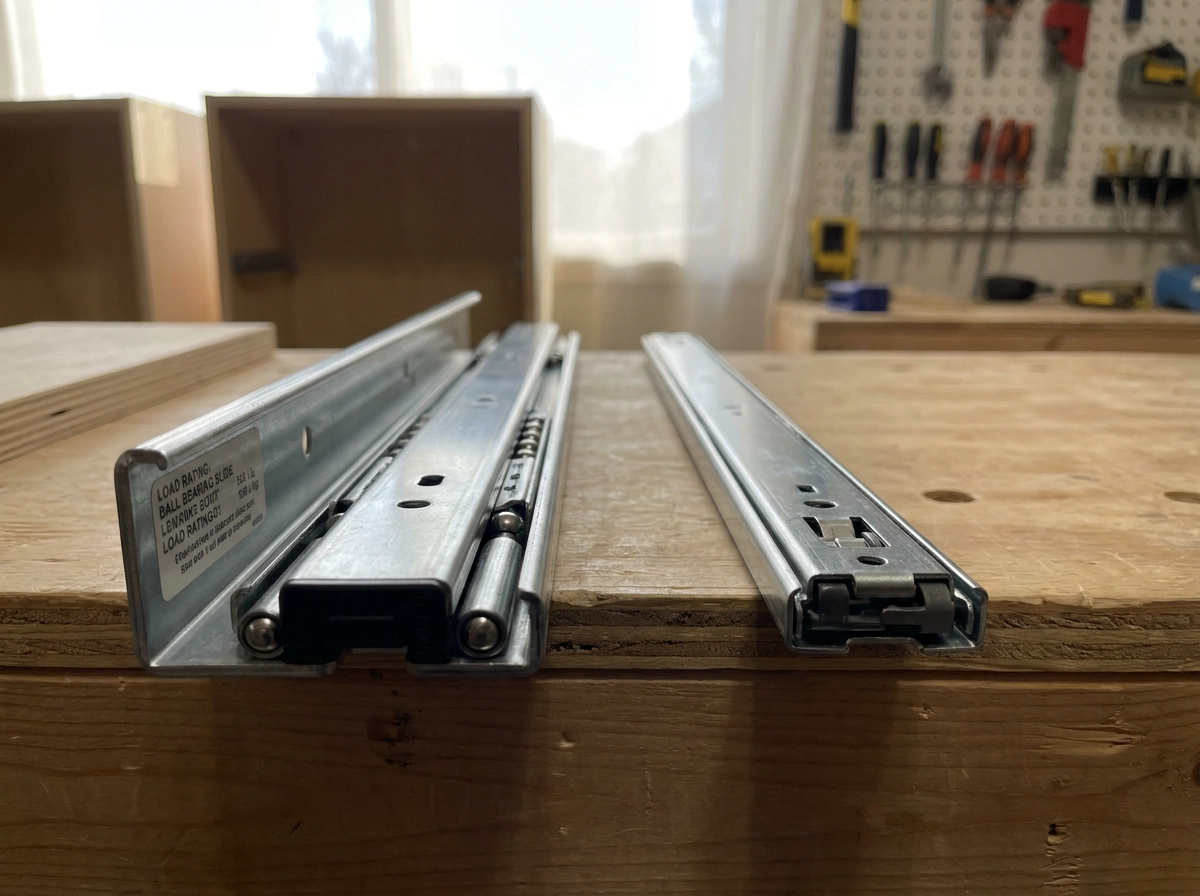
Light-duty series (45 to 80 kg per pair) suit static residential furniture, light workshop storage, and interior van fitouts where drawer weights are low and vibration is not a factor. These are not appropriate for mobile or outdoor Australian applications.
Medium-duty series (100 to 150 kg per pair) cover most 4WD canopy, camper trailer, and caravan drawer builds. They deliver the load capacity, construction quality, and cycle life needed for regular on-road use and mild off-road conditions.
Heavy-duty series (200 kg per pair and above) are specified for toolboxes carrying heavy loads, industrial equipment drawers, commercial workshops, and serious off-road builds where combined static and dynamic forces are at their highest.
Fridge slide series are a distinct category, not a repurposed drawer slide. They are engineered for concentrated refrigerator loads, smooth low-friction operation, and full-extension travel so the fridge clears the enclosure completely for door access and ventilation.
Fridge Slides: A Special Case Worth Calling Out
Purpose-built fridge slides differ from standard heavy-duty slides in a fundamental way: they are engineered around the specific load geometry, extension travel, and operational demands of a refrigerator in a moving vehicle or caravan, not just rated for the equivalent weight.
Full extension is non-negotiable. The fridge must clear the enclosure completely to open the door, maintain the airflow clearances the appliance requires to operate efficiently, and allow access to power leads or gas fittings at the rear. A partial-extension slide fails this application regardless of its load rating.
For load calculations, work from fridge weight plus a dynamic load factor to account for corrugated roads and off-road conditions. A 60 L fridge at 40 kg fully stocked, mounted on a slide rated to 120 kg per pair, gives an appropriate safety margin for real-world use.
Retention is a separate consideration. In a caravan or camper trailer, the fridge needs to be positively secured during transit, either through the slide’s own locking mechanism or a secondary strap or retention system.
Finally, check the installed height of the slide assembly before committing to a product. The combined height of slide and fridge must fit within the enclosure clearance. For tight installations, confirm whether a tilt or fold-down mechanism is required to gain the access angle your setup demands.
Use the Drawer Slide Finder to Get Your Selection Right
With all the selection variables covered in this guide, the Trailer Parts Direct Drawer Slide Finder consolidates every decision point into a single tool and returns a matched product recommendation based on your specific inputs.
Before you start, have these details ready:
- Application type (4WD canopy, caravan, toolbox, workshop, fridge slide, etc.)
- Available mounting depth inside the enclosure
- Total expected load per drawer, including contents
- Environmental conditions (sheltered, coastal, marine, open exposure)
- Locking requirement (closed, open, both, or none)
The finder covers the full range: standard steel locking and non-locking slides, stainless steel slides for corrosive environments, heavy-duty series for high-load builds, and dedicated fridge slide options.
If your application is unusual, or your load sits at the boundary between two series, treat the finder result as a confirmed starting point rather than a final answer. The Trailer Parts Direct team can verify the correct specification for non-standard builds before you purchase.
Running the finder before you buy eliminates the most common selection mistakes and confirms the slide you receive is rated for your actual application.
Get the Selection Right the First Time
Selecting the right drawer slide comes down to six decisions, made in order: application, load, length and extension, locking requirement, material, and mounting method. Work through each one systematically and the correct product becomes obvious. Skip one and you risk a slide that binds, corrodes, fails under load, or opens in transit.
Australian 4WD, caravan, tradie, and fabrication applications operate under conditions that residential hardware guides and international sources simply do not address. Corrugated outback roads, coastal salt air, and toolboxes that travel daily place demands on slides that standard cabinetry hardware was never designed to meet.
The Drawer Slide Finder is the fastest path to a confirmed selection. Use it with your application, load, dimensions, environment, and locking requirement ready and it returns a matched product from the full Trailer Parts Direct range, covering light-duty non-locking slides through to heavy-duty stainless steel locking slides and purpose-built fridge slides.
For non-standard or complex builds, where loads are unusually high, environments are particularly harsh, or the enclosure geometry is uncommon, contact the Trailer Parts Direct team directly. Application-specific guidance is available, and getting the specification confirmed before you build saves significantly more time than resolving a fitment problem after the fact.
Conclusion
Choosing the right drawer slide is not complicated, but it does require working through the right decisions in the right order. Know your application, calculate your load, match your dimensions, determine your locking requirement, choose the correct material for your environment, and confirm your mounting method. Every step matters.
Australian 4WD, caravan, and tradie builds face conditions that standard hardware was never designed to handle. Getting the specification right before you build protects your investment and eliminates costly rework down the track.
Use the Drawer Slide Finder to match your requirements to a confirmed product from the Trailer Parts Direct range. For complex or non-standard builds, reach out to the team directly for application-specific guidance.
The right slide, selected correctly the first time, performs reliably for the life of your build. Start with the Finder and get it right from the start.