
Uncategorized
Compression Latches, Cam Locks and Draw Latches: Which Holds Under Pressure?
Oct
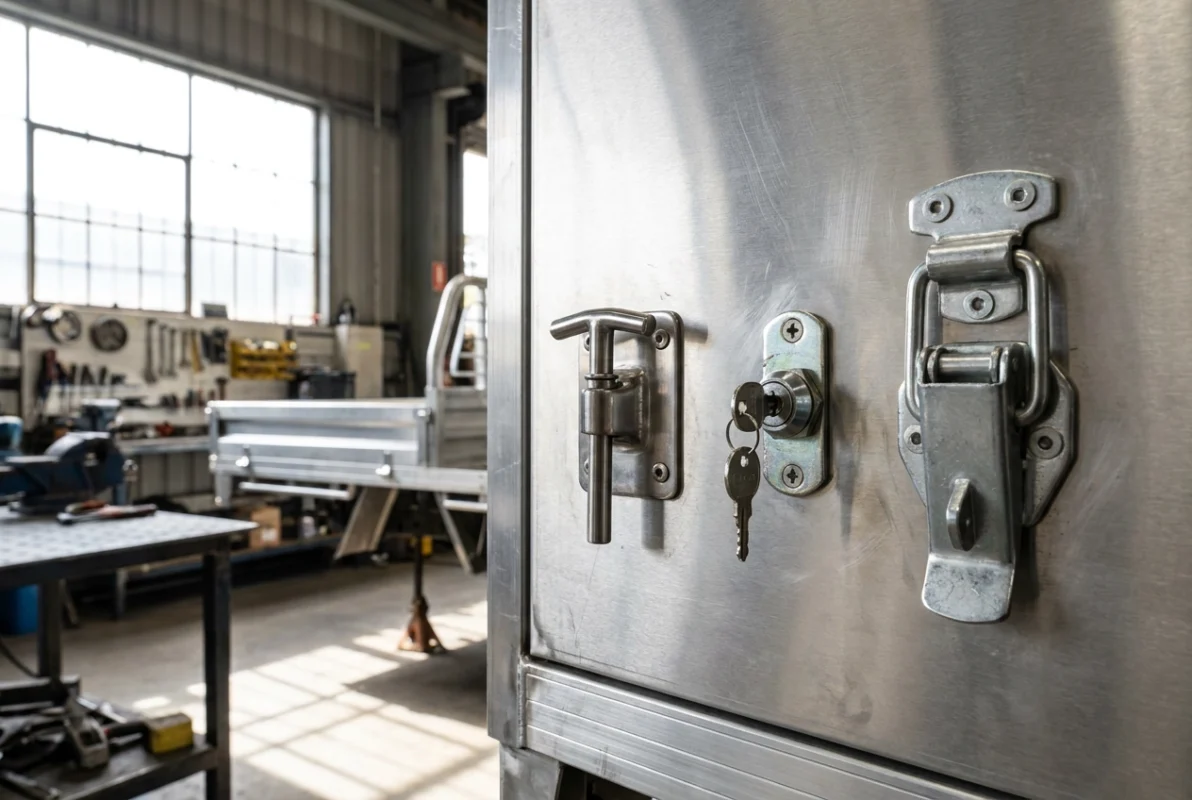
A latch that looks the part but fails on a moving vehicle is not a latch; it is a liability. For van fitters and workshop fabricators specifying cabinet latches on professional builds, the difference between a secure closure and a rattling drawer mid-motorway comes down to mechanism type, material finish, and how well the hardware suits the panel it is mounted to.
Compression latches, cam locks, and draw latches each solve the closure problem differently, and each has a distinct performance profile under vibration, weather exposure, and repeated daily use. Choosing the wrong type does not just mean an annoying rattle. It can mean unsecured tools, water ingress into electrical enclosures, or a costly retrofit on a van that is already in service.
This guide works through all three mechanism types in detail, covering how each operates, where it performs best, and how factors like keyed access, panel thickness, and coastal weatherproofing should shape your specification. By the end, you will have a clear framework for matching the right latch to the right application, the first time.
Why Latch Selection Matters More Than Most Fabricators Expect
Most mass-market toolboxes ship with tension-based latches engineered to a price point, not a performance standard. As recently as August 2025, professional tradespeople in active industry forums were raising concerns about inadequate drawer latch provision on mass-market toolboxes.
The stresses acting on cabinet latches in a working van or fabricated workshop unit go well beyond what cosmetic-grade hardware was designed to handle: continuous vibration cycles, thermal expansion across steel panels, and moisture ingress from wash-downs and weather exposure all degrade mechanisms that look adequate on a shelf.
Specification variables matter equally. Panel thickness, enclosure material, access frequency, and whether the installation requires keyed security each influence which latch type is genuinely fit for purpose. A standard DIY cupboard door latch spec addresses none of these.
The consequences of a latch failure in transit are not limited to a replacement part. Unsecured tools in a moving vehicle represent a genuine injury risk and a source of job-site downtime, making latch selection a risk management decision.
This comparison covers the three mechanisms used in professional-grade toolbox and cabinet applications: compression latches, cam locks, and draw latches, with selection criteria mapped to real fabrication scenarios.
Compression Latches: How They Work and Where They Excel
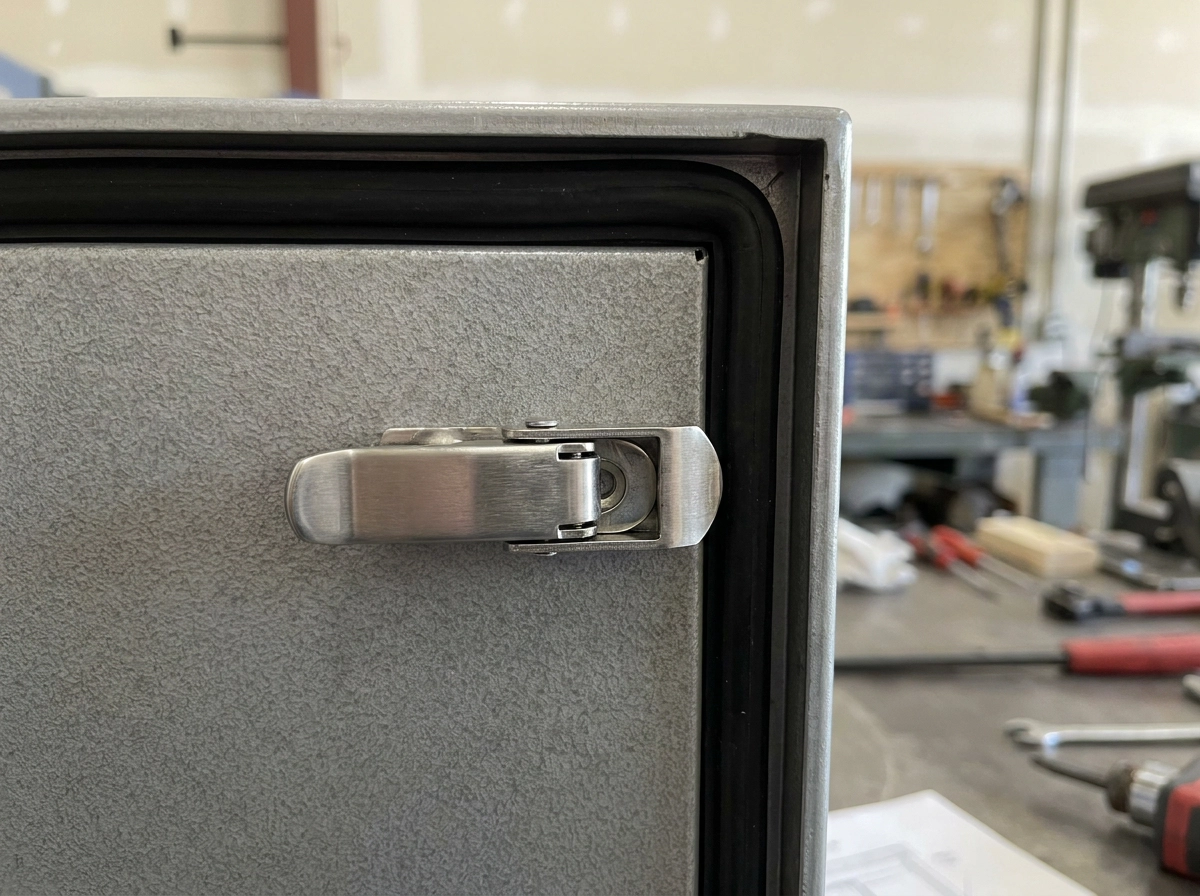
A compression latch works differently from the other mechanisms covered in this comparison. As the handle rotates, a cam draws the door or panel inward, applying consistent clamping force directly against a gasket or seal. That inward pull is the defining characteristic: the closure is held under positive compression, not surface contact or spring tension.
This makes compression latches the correct specification wherever weatherproofing is a hard requirement. Ute canopy toolboxes, outdoor enclosures, generator housings and trailer storage bays all benefit from positive gasket compression that a cam lock or draw latch cannot replicate. The seal is active, not incidental.
The category is highly modular. EMKA alone lists over 1,285 quarter-turn and compression latch variants, with handle style, panel cut-out diameter, grip depth and locking cylinder all specifiable independently. This modularity means the correct configuration exists for most professional fabrication scenarios, but the wrong configuration is equally easy to order.
Panel thickness is the most critical specification variable. Compression latches carry a defined grip depth range per SKU, confirm the manufacturer’s stated panel range before ordering, as budget and professional-grade units vary significantly. Confirm your actual fabrication stack-up, including door skins and any internal reinforcement, before ordering.
Keyed variants use interchangeable lock cylinders in standard profiles, making master-key fleet fitouts straightforward across multiple vehicles.
The primary limitation is installation tolerance. Compression latches require a precise circular cut-out and a flat panel face. Any bow or warp in a fabricated steel door reduces gasket contact and compromises the seal, a trade-off that draw latches, applied externally, avoid entirely.
Cam Locks: Rotational Engagement for High-Access Cabinets
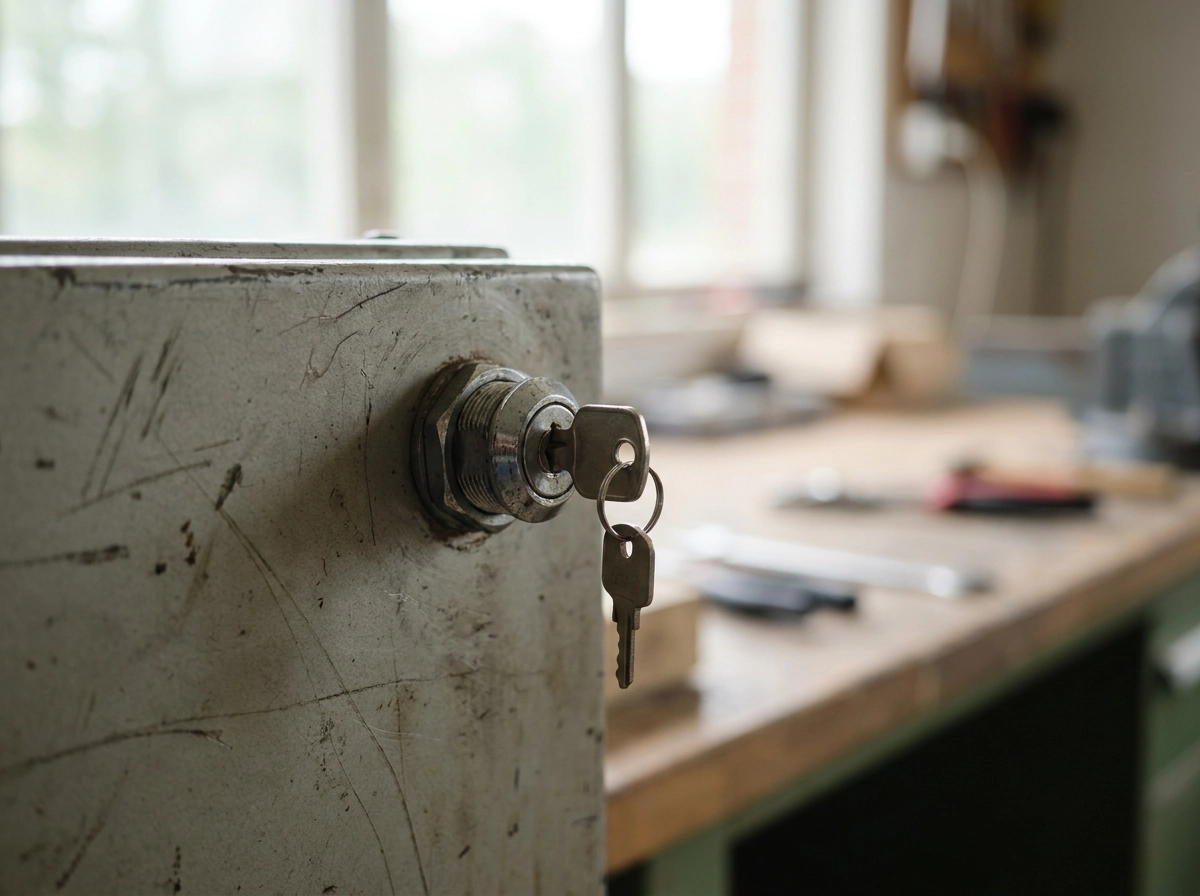
Where compression latches apply clamping force to seal a panel, a cam lock works differently: a rotating cam plate, driven by a keyed cylinder or thumb-turn, swings to engage a strike or the cabinet frame edge directly. The locking action is purely rotational, with no compressive force applied to the panel face.
That distinction defines where cam locks belong. They dominate workshop wall cabinets, drawer banks, electrical enclosures and any installation where keyed security and fast single-hand operation matter more than sealing. When multiple people need controlled access to shared storage, a keyed cam lock with a consistent cut-out and simple quarter-turn operation is the practical default.
The absence of compressive sealing force is the critical limitation for outdoor use. Pairing a cam lock with a separate compression gasket is possible, but it adds cost and assembly steps; a compression latch handles both functions in a single unit.
Vibration performance is where cam lock quality tiers diverge sharply. Cheap units with shallow cam profiles will rattle under sustained road vibration and can back-rotate over time. Quality cam locks with deep positive-stop cams and adequate spring tension maintain reliable engagement in vehicle applications. For van fitouts, this distinction matters far more than on a static workshop cabinet.
Standardisation is a genuine practical advantage. Cam locks require a standardised small-diameter circular cut-out, confirm the specific diameter with your chosen manufacturer, simplifying retrofitting and keeping replacement costs low.
Keyed-alike batch ordering is worth noting for fleet work. A full van fitout covering every drawer and wall cabinet can be specified on a single key, eliminating a large key bundle on the job.
Draw Latches: Linear Pull Mechanisms for High-Vibration Closures
Where cam locks trade on rotational simplicity and keyed security, draw latches take a fundamentally different approach: a handle-and-linkage assembly pulls a keeper toward the cabinet face, generating defined clamping force through toggle action alone, no tool or key required.
The critical engineering characteristic is over-centre geometry. Once the toggle mechanism passes its dead-centre point, the geometry itself resists back-travel. Vibration cannot drive the latch open because the mechanism is locked by position, not spring tension. Protex, which self-identifies as the world’s leading over-centre latch manufacturer, has built its entire product range around this principle, and it is the reason draw latches are the preferred choice for heavy steel lids, generator covers, portable equipment cases and any enclosure subject to sustained load and road vibration.
Holding force is a genuine advantage. Professional-grade draw latches can reach load ratings up to 5,000 N, which exceeds what most cam locks deliver at a comparable price point.
The trade-off is security. Keyless operation is fast, but a toggle snagged during transit can release accidentally, and there is no barrier to unauthorised access. Draw latches are not appropriate where theft deterrence is a requirement.
Two installation advantages make them practical for retrofit work. Keeper position is adjustable on most professional units, giving broader panel thickness compatibility than compression latches without special-order components. More significantly, draw latches are surface-mounted: they bolt to the external face of door and frame with no panel cut-out, meaning they can be fitted to an existing toolbox without a hole saw or machining.
Vibration Resistance: How Each Latch Type Performs on the Road
Knowing how each mechanism handles vibration is where specification decisions become consequential for vehicle use.
Tension-based closures fail progressively. Spring tension degrades through vibration cycle fatigue: latches begin to rattle, then intermittently release, then fail completely after months of daily road use.
Compression latches offer the strongest all-round vibration resistance for sealed enclosures. The gasket compression holds the panel mechanically closed as a secondary mechanism; even if the latch spring partially fatigues, the compressed gasket maintains closure.
Draw latches with over-centre geometry, as described in the mechanism section above, hold the strongest position for high-vibration, heavy-load closures.
Cam locks carry the most vibration risk when spring quality is marginal. A shallow cam profile under sustained vibration can back-rotate and disengage. In a vehicle application, specifying a cam lock with a documented positive-stop cam profile is critical; on a static workshop cabinet, it is simply a preference.
For van fitouts with drawer banks, experienced fabricators combine cam locks on upper cabinets with drawer slide detent systems on drawers, rather than relying solely on face-mounted latches. Latch selection is part of the full storage system specification, not an isolated hardware decision.
Weatherproofing and Material Finish for Outdoor and Coastal Use
Beyond vibration performance, outdoor and coastal use introduces a second set of failure modes that latch selection must address directly.
Compression latches, the only mechanism of the three with built-in gasket compression, offer the strongest weatherproofing, their application to outdoor enclosures is covered above. Material finish then becomes the next variable.
Material finish determines service life. Zinc-plated steel performs adequately in dry workshop environments but corrodes within months in coastal, high-humidity or agricultural use. Stainless steel is the correct specification wherever salt air, chemical exposure or regular wash-downs are part of the operating environment.
Stainless draw latches benefit from simpler manufacturing tolerances than compression latches, as surface-mount construction requires no precision internal cam mechanism. Stainless compression latches command a higher premium; the cam mechanism requires tighter manufacturing tolerances, and that cost is reflected in the price.
Powder-coated finishes are not a substitute for stainless construction. Coating offers UV and surface corrosion resistance but chips quickly at high-wear contact points such as the rotating cam and keeper edge. Once the substrate is exposed under daily trade use, corrosion proceeds rapidly.
One critical detail: always confirm the lock cylinder specification separately from the latch body. Many stainless-steel compression latches ship with zinc-alloy cylinders that will corrode and seize prematurely in coastal environments, regardless of the body finish.
Keyed vs Keyless: A Practical Decision Framework for Professional Fitouts
Material finish addressed the what of latch specification; the keyed versus keyless decision addresses the who and when of access.
Security versus closure retention are distinct requirements. Keyless draw latches and compression latches without lock cylinders offer no resistance to opportunistic theft; a van parked unattended on a job site is vulnerable if the only closure mechanism is a toggle or quarter-turn handle. Keyed cam locks and lockable compression latches add a meaningful deterrent precisely because they require a key to defeat.
Fleet fitouts introduce an additional operational dimension. Keyed-alike cam locks, ordered as a matched batch, allow every technician to use a single key across all vehicles. Keyless alternatives cannot replicate this; managing access across multiple unkeyed enclosures relies entirely on physical vehicle security.
Keyless latches remain appropriate where the enclosure sits inside a locked vehicle or outer cabinet and the latch function is purely vibration retention and closure, not access control.
Padlockable draw latches provide a practical middle ground. The toggle operates freely during the working day; clip a padlock through the hasp when the vehicle is left unattended. This flexibility is not available with a fixed-cylinder cam lock.
Access speed has a genuine productivity cost. On high-frequency-access drawers, keyless latches are meaningfully faster than keyed cam locks over the course of a working day. This is worth accounting for before specifying keyed hardware on high-frequency-access drawers.
Panel Thickness, Cut-Out Requirements and Installation Compatibility
Once access requirements are settled, panel thickness is where orders most commonly go wrong.
Compression latches carry a defined grip depth range per SKU. A folded steel door with internal reinforcement can easily stack to 5 mm or 6 mm total; fitting a latch rated for a thinner panel means the cam cannot complete full travel and the gasket never seats. Confirm the actual fabrication stack-up before ordering, not the nominal sheet gauge.
Cam locks require a clean circular cut-out, a standardised small-diameter hole; confirm the specific diameter with your chosen manufacturer. Thin sheet metal is prone to deformation around the hole under torque; fit a backing plate or reinforcement washer to prevent the cylinder rotating or pulling through.
Draw latches require no cut-out. They bolt to the external face of both door and frame, making them the straightforward choice for retrofits where hole-sawing is not practical.
For aluminium extrusion toolboxes, check that fasteners supplied with compression latch kits suit the extrusion wall thickness. Most kits are packaged for steel panels; self-tapping screws sized for 2 mm steel strip threads in 2 mm aluminium and will not hold reliably.
Hardware-store cabinet latches are typically dimensioned for residential substrates such as thick MDF or plywood, not the thin-gauge steel or aluminium panels standard in van and trailer fabrication. Always verify the manufacturer’s stated panel range before substituting.
Compression Latch vs Cam Lock vs Draw Latch: Side-by-Side Summary
With installation variables covered, here is how the three types stack up for specification decisions.
| Compression Latch | Cam Lock | Draw Latch | |
|---|---|---|---|
| Best for | Outdoor enclosures, ute canopy toolboxes, sealed trailer bays | Workshop cabinets, drawer banks, fleet keyed-access | Heavy lids, high-vibration closures, retrofit installs |
| Weatherproofing | Highest (gasket compression) | None | None |
| Vibration resistance | Moderate | Spring-dependent | Highest (over-centre geometry) |
| Security | Keyed or keyless | Keyed standard | Keyless; padlockable variants available |
| Installation | Precise cut-out required | Standardised circular cut-out, confirm diameter with manufacturer | Surface-mount; no cut-out |
| Panel thickness | Limited range per SKU | Moderate | Broad; keeper is adjustable |
Crossover scenarios in practice:
- Outdoor trailer storage bay: compression latches with stainless steel bodies
- Portable equipment case: draw latches for over-centre vibration lock-up in transit
Budget tier note: Quality tier matters most with cam locks (spring tension and cam depth) and compression latches (grip depth range and gasket material). Draw latches are the most forgiving at lower price points because the over-centre geometry delivers vibration lock-up regardless of spring quality.
Specifying the Right Latch: Actionable Takeaways
Apply the comparison findings as a practical checklist before you order.
Define your primary requirement first. Weatherproofing specifies a compression latch. Keyed security with fast multi-user access specifies a cam lock. High-vibration or heavy-lid closures specify an over-centre draw latch. Starting from the wrong requirement wastes both money and installation time.
Measure your panel stack-up before selecting a compression latch. As covered in the panel thickness section, grip depth determines whether the cam achieves full travel and whether the gasket seats correctly, a latch mismatched to a reinforced steel door will neither seal nor lock regardless of price.
Specify stainless steel bodies for any outdoor, coastal or wash-down installation. As covered in the weatherproofing section, confirm the lock cylinder material independently from the body finish; many otherwise-stainless compression latches ship with zinc-alloy cylinders that will corrode and seize prematurely in coastal environments.
Reject tension-based closure systems for any vehicle-mounted storage. Specify either over-centre draw latches or compression latches with positive gasket compression as the minimum standard. Spring-tension closures degrade under vibration cycles and do not maintain tool security in transit.
Trailer Parts Direct supplies professional-grade compression latches, cam locks and draw latches with specifications matched to fabrication-grade panel thicknesses used in ute, trailer, van and workshop cabinet builds, not residential cabinetry dimensions.
Conclusion
Latch selection is not a minor specification detail. It determines whether your build holds up under pressure, vibration, weather and repeated daily use. Get it wrong and you face corroded cylinders, rattling closures and tool security failures in the field.
The core principles are straightforward: match your latch type to your primary requirement, verify panel stack-up before ordering compression latches, specify stainless steel for any outdoor or coastal exposure, and reject tension-based systems for anything vehicle-mounted.
These decisions are easier when your supplier stocks fabrication-grade hardware rather than residential equivalents scaled down to look similar.
Trailer Parts Direct carries compression latches, cam locks and draw latches built to the panel thicknesses and load requirements that professional fabricators actually work with. Browse the range, confirm your specifications and order with confidence that the hardware will perform exactly as your build demands.