
Uncategorized
Heavy-Duty Drawer Runners for Van Racking and Workshop Cabinets: Load Ratings and Full-Extension Options Explained
Oct
Household drawer runners rated at 35 kg will fail within weeks when loaded with power tools, angle grinders, and heavy fixings. For anyone building van racking, equipping a workshop cabinet, or fitting out a site box, this is not a hypothetical scenario; it is an expensive and frustrating reality that plays out regularly when buyers underspecify their hardware.
Selecting the correct heavy duty drawer runners for these applications requires more than picking the highest load rating on a product page. Slide length, steel thickness, extension percentage, installation orientation, and whether the storage is stationary or mobile all determine whether a runner performs reliably under repeated daily use or degrades rapidly under load.
This guide works through everything an intermediate buyer needs to make a confident specification. You will learn why kitchen-grade runners are structurally unsuitable for van and workshop use, how to interpret and calculate real working loads, the practical differences between full and partial extension, and how locking mechanisms address safety in mobile environments. By the end, you will have a clear framework for selecting runners that are correctly rated, properly constructed, and matched to your specific application.
Why Kitchen-Grade Runners Fail in Van and Workshop Applications
Household drawer runners sold for kitchen and bedroom furniture are typically rated up to 45 kg per pair, tested under static, horizontal, controlled laboratory conditions. That test environment bears no resemblance to a panel van grinding through a potholed industrial estate or a workshop cabinet being hammered open fifty times a day.
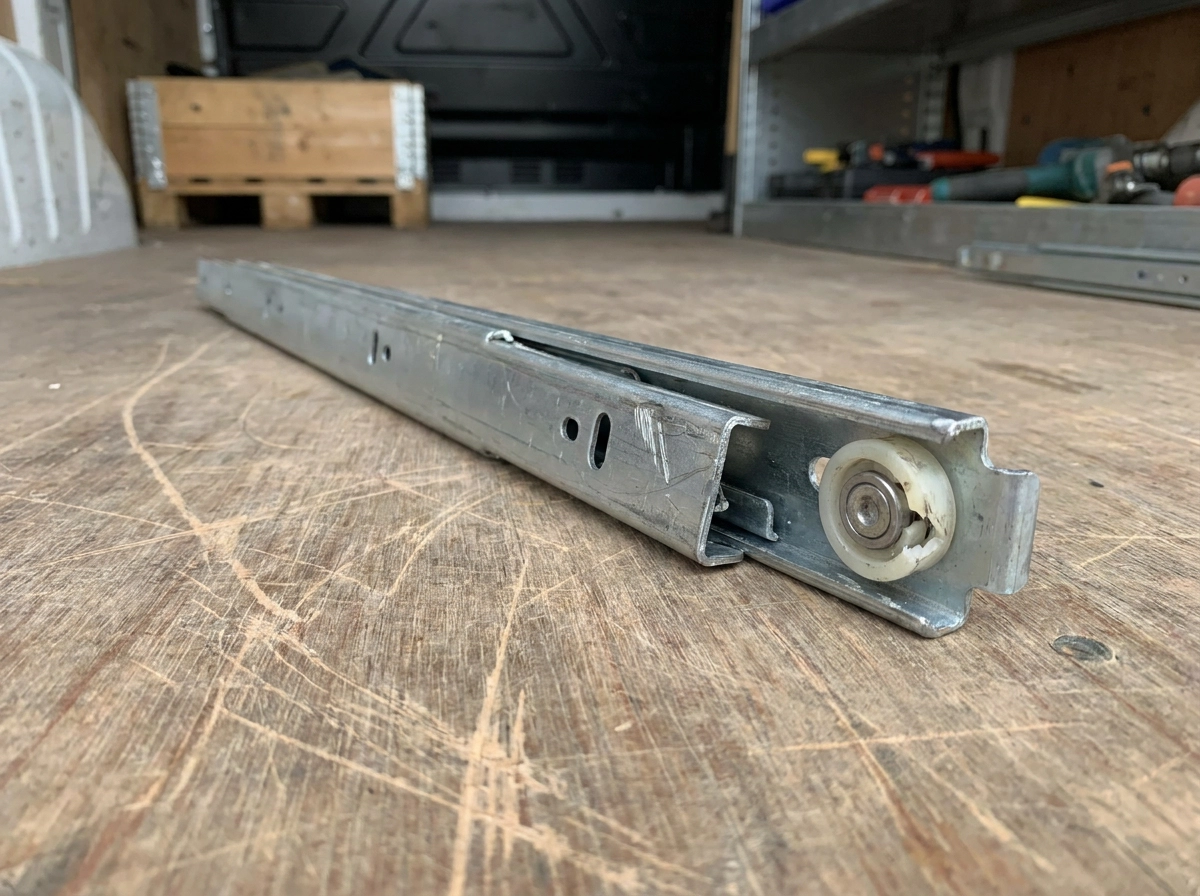
The gap in material specification matters just as much as the load figure. Residential runners are pressed from lighter-gauge sheet steel, adequate for a cutlery drawer but not for sustained off-centre loading. Heavy-duty drawer runners use thicker cold-rolled steel, which resists the gradual deflection that thinner rail sections develop when load is concentrated away from the centre of the runner.
Van racking introduces failure modes that no static test captures. Continuous road vibration, pothole shock loads, and lateral force during cornering all work against the ball-bearing carriage and outer rail simultaneously. A runner that passes its rated static cycle test at a desk can develop play in the bearing cage within months of mobile use, because the rating was never derived from dynamic conditions.
Workshop cabinets present a different but equally destructive problem. When a deep tool drawer is opened fully, the weight of spanners, sockets, and power tool accessories concentrates near the front of the drawer box. This creates a cantilevered load, a lever effect acting on the runner mounting points. Lighter residential designs lack the rail cross-section and bearing cage length to resist this moment load without deflecting.
The resulting failure patterns are consistent and recognisable: bent ball-bearing cages that bind mid-travel, deformed outer rails that cause the drawer to drop on one side, and collapsed locking tabs that allow the drawer to slide open unexpectedly. Each of these failures tends to occur at the worst possible time, mid-job, with tools inaccessible and rework required to extract a jammed drawer box. Selecting runners specified for the actual application prevents all three.
Understanding Load Ratings: What the Numbers Actually Mean
Once you know why residential runners fail, the next question is how to read heavy-duty specifications accurately. A published load rating is not a universal number; it describes performance under a specific tested configuration. The same “150 kg” figure on two different heavy-duty drawer slides can represent completely different real-world capacity depending on slide length, drawer width, installation orientation, and the test methodology used to derive it.
Pair rating vs. per-slide rating
This is the most consequential distinction to check before purchasing. Some manufacturers publish a per-pair rating; others publish a per-slide figure. If you order slides rated at “100 kg” assuming that means the pair, but the rating applies to each slide individually, you have halved your effective load capacity before the drawer is even built. Always confirm which convention the manufacturer uses. If the datasheet does not state this explicitly, contact the supplier before specifying.
Test load vs. working load
Manufacturers derive load ratings by cycling slides to the rated load under controlled laboratory conditions, typically across 50,000 to 100,000 open-and-close cycles. That rated figure is not your working load limit; it is the ceiling at which the slide completed its test protocol. For professional van racking and workshop use, apply a minimum safety factor of 1.5x. A drawer carrying 60 kg of tools requires slides rated to at least 90 kg, not 60 kg, to maintain performance over service life.
Slide length and extension position
Load capacity degrades as the drawer extends. A 500 mm slide rated at 150 kg in the closed or mid-travel position will carry less at full extension, because the ball-bearing carriage is further from the mounting points and the cantilever stress increases. Always locate the load-at-full-extension figure in the published data table, not just the headline rating.
Cycle ratings and service life
A heavily used workshop tool drawer can accumulate 50,000 cycles within a few years of daily use. Select slides with a published cycle rating that matches your expected installation life; a higher cycle rating indicates more robust bearing retention and rail construction, not just a marketing claim.
How to Calculate the Real Working Load for Your Drawers
With the rating framework established, you now need to calculate the actual number before you can select a runner.
The working load formula is straightforward:
Drawer box weight + drawer face weight + tray or liner weight + maximum cargo weight = total working load per pair
Apply a 1.5x safety factor to that total to arrive at your minimum required runner rating.
Van Racking Example
| Component | Weight |
|---|---|
| Steel drawer box | 8 kg |
| Aluminium face | 1.5 kg |
| Tool tray | 2 kg |
| Power tools and fasteners | 28.5 kg |
| Total working load | 40 kg |
40 kg × 1.5 = 60 kg minimum pair rating. Select heavy-duty drawer runners rated at 60 kg or above per pair.
Workshop Cabinet Example
| Component | Weight |
|---|---|
| Timber drawer box | 5 kg |
| MDF face | 2 kg |
| Hand tools and sockets | 43 kg |
| Total working load | 50 kg |
50 kg × 1.5 = 75 kg minimum pair rating for heavy-duty drawer runners in this application.
Adding the Dynamic Load Factor for Mobile Applications
A static calculation is sufficient for a fixed workshop cabinet. For vans, utes, and site boxes, it is not. Road shock, cornering forces, and vibration create instantaneous loads that exceed the static figure. Apply an additional dynamic factor, most van racking specialists recommend a minimum of 1.5x, on top of the static working load.
The 60 kg static van racking load from the example above becomes 90 kg or more of dynamic demand in practice. Specify runners accordingly, or that safety margin disappears on the first corrugated access road.
Cantilevered Load at Full Extension
Drawer depth compounds this further. When a drawer extends beyond 500 mm, the load’s centre of mass shifts away from the runner mounting points. A 40 kg load positioned 400 mm forward of the runner front at full extension generates a rotational moment force significantly greater than the same load centred in a closed drawer. This is a bending stress problem, not just a weight problem. For deep drawers, verify that the runner’s published rating explicitly covers full-extension loading, not only the closed or mid-travel position.
Full Extension vs. Partial Extension: Why It Matters for Tool Access
Once you have confirmed your working load and applied the appropriate safety factors, the next variable is how far the drawer actually travels, and that determines how much of it you can use.
Full-extension heavy duty drawer runners allow the drawer box to travel the full depth clear of the cabinet face. Every centimetre of the drawer floor is accessible without tilting or removing the drawer. For a workshop cabinet holding long-handled spanners, ratchet extensions, or stacked socket sets, that matters practically: items at the rear are visible and retrievable in a single movement.
Partial-extension slides, which typically provide around 75% travel (check manufacturer specifications, as travel percentages vary by product), leave the rear portion of the drawer permanently obstructed by the cabinet frame. In a kitchen holding cutlery, that is a minor inconvenience. In a van racking system or site cabinet where a specific socket or drill bit needs to be found in seconds, inaccessible rear storage creates real inefficiency and encourages overpacking the front of the drawer, which concentrates load poorly.
Over-travel slides extend beyond 100%, sometimes called super-extension. These are useful where the cabinet face sits flush against a bulkhead or wall and the drawer must travel further forward to provide clearance to reach the rear. In tight van builds, over-travel runners solve a fitment problem that no other configuration addresses.
Extension percentage and load capacity are directly related. At full extension, the ball-bearing carriage operates under greater cantilever stress than at mid-travel or fully retracted. Some manufacturers publish a reduced load rating at full extension compared to their headline figure. Always confirm that the rated capacity applies at full extension for the specific slide length you are selecting, not just at the closed position.
As a practical threshold: for any deep tool drawer, full-extension runners are the functional minimum. A 600 mm deep cabinet fitted with partial-extension slides will leave a significant portion of rear depth permanently out of reach, the exact loss depending on the travel percentage of the specific slide.
Steel Thickness, Construction Quality, and Corrosion Resistance
Extension percentage tells you how far the drawer travels; steel specification determines whether the slide survives the journey.
Steel gauge and load capacity are directly linked. Heavier-gauge cold-rolled steel is the practical requirement for runners rated at 100 kg per pair and above. Higher load-rated slides use reinforced outer channels with increased steel mass, which handle greater cantilever stress at full extension without rail twist.
Bearing retention is the second construction variable that separates industrial-grade from budget slides. Quality heavy-duty drawer slides use full-length ball-bearing cages that hold each bearing in a fixed, evenly spaced position across the full travel length. Individual loose bearings, common in lighter residential runners, migrate under load and can eject under shock loading, such as a van hitting a pothole or a workshop drawer dropped hard into its closed position. Caged systems maintain consistent bearing contact across the rail surface, which sustains smooth travel through high cycle counts and prevents the progressive stiffness that develops when bearings cluster at one end of the carriage.
Finish selection should match the operating environment directly. Zinc-plated steel is the standard finish for indoor workshop cabinets in dry conditions and performs adequately when kept clean and lubricated. In coastal workshops, marine environments, or applications involving chemical exposure, stainless steel drawer runners are the correct choice; they eliminate the rust-related seizure and brown staining that zinc-plated runners develop once the plating is scratched or worn.
UK coastal and high-humidity workshop environments accelerate surface corrosion on plated steel, particularly on unenclosed site boxes and outdoor racking where the runners are not regularly cleaned. Stainless steel or heavy zinc-plate finishes are the practical choice for any exposed application where maintenance will be infrequent.
Weld quality and machined tolerance at the rail-to-bracket interface distinguish industrial-grade slides from lower-cost alternatives. Loose tolerances introduce lateral play that tightens under load rather than resolving it, producing the characteristic drawer rattle in van racking installations. Industrial-grade slides hold close tolerances at the weld joint so the rail-to-bracket interface remains rigid under both static weight and dynamic road load.
Locking Drawer Runners for Van Racking and Mobile Storage
Material selection and corrosion resistance determine whether a runner survives the environment; locking determines whether it survives the journey.
Locking drawer slides incorporate an integrated mechanical lock that holds the drawer closed during vehicle movement, preventing unintended opening under braking, cornering, or road shock. In any van conversion or site transport application, this is a safety requirement, not an optional feature.
Two distinct lock types serve different functions. An in-travel lock secures the drawer in the fully closed position during transit, resisting the inertial forces of acceleration and braking. An open-position lock holds the drawer at full extension during use, preventing it from sliding back under vibration while the user is working. Professional van racking installations benefit from both: in-travel lock for road use, open-position lock for controlled access at the worksite.
When selecting runners for mobile applications, ask specifically for the lock retention rating under dynamic conditions, not just the static pair rating. Some manufacturers publish shock-load holding figures; many do not, and the lock’s holding strength under emergency braking or pothole impact is a separate consideration from the slide’s static load rating.
Industrial locking drawer slides are available with high pair ratings, combining full-extension travel with positive locking at both closed and open positions. This configuration is the functional standard for professional van racking and heavy toolbox installations where tools cannot be permitted to shift in transit.
Non-locking runners in mobile applications carry a longer-term cost that is easy to overlook. Corrugated outback tracks, highway vibration, and the abrupt stops of urban tradie use create cumulative fatigue in the ball-bearing cage. Over time, this develops into lateral play in the runner, producing the drawer rattle and degraded travel feel common in older van racking built with unlocked slides. Specifying locking runners from the outset eliminates this failure mode before it starts.
Selecting Heavy-Duty Drawer Runners by Application
With locking behaviour addressed, the remaining variable is matching the correct runner specification to your specific build type.
Van racking and ute canopy drawers demand a robust pair rating, full extension, and positive in-travel locking as a baseline. Finish selection follows exposure: zinc-plate is adequate for enclosed van racking; stainless steel is preferable in open ute canopies or coastal environments where moisture ingress is consistent. Side-mount configuration is the practical choice for adjustable racking systems, as it allows the slide height to be repositioned on slotted uprights after installation without rebuilding the drawer box.
Workshop cabinet and toolbox drawers have more flexibility, with the appropriate rating driven by drawer depth and expected tool load. Full-extension runners are the functional standard for deeper drawers. Locking is optional in a single-user static workshop but becomes worth specifying in shared-access environments or where the cabinet is subject to floor vibration from machinery. Under-mount slides are worth specifying where the drawer front must sit perfectly flush, as they eliminate the side-rail reveal visible on face-frame cabinets.
Site boxes and portable storage present the harshest mechanical environment after vehicle-mounted applications. Repeated loading onto utes, trailers, and site floors generates impact shock that degrades standard runners quickly. Specify robust rated runners with stainless or heavy zinc-plate finish and integrated locking. Slide lengths should match the drawer box depth without overhanging the box.
Camper trailer and caravan drawers require attention to cycle counts, as vibration exposure is continuous over long touring distances. Full extension is critical where access space beside the van is limited. Stainless steel drawer runners are increasingly the standard in quality caravan builds, particularly for coastal and off-road touring where zinc-plated runners are prone to corrosion.
4WD and overland vehicle drawers require high-rated locking runners built to handle off-road vibration and dust ingress. For under-tray or exposed installations, stainless steel or powder-coat finishes outlast bare zinc plate significantly in outback and high-humidity conditions.
Installation Considerations for Van and Workshop Applications
Selecting the right slide specification means nothing if the installation undermines it. A 150 kg-rated runner mounted to thin ply without backing will deform the substrate long before the slide itself reaches its limit. Use adequate-thickness structural ply (consult the slide manufacturer’s substrate guidance) or steel box section as the cabinet substrate in van racking builds. In a moving vehicle, the mounting surface carries dynamic loads that far exceed the static weight of the drawer contents, and thin sheet materials flex, delaminate at the fastener holes, and fail progressively under repeated road vibration.
Fastener choice is equally critical. Wood screws are not adequate for high-cycle or vibration-prone installations. Use appropriate-grade bolts with flat washers and nyloc or prevailing-torque nuts throughout, wood screws lack the clamping force and vibration resistance required.
Alignment tolerance is tighter than most builders expect. Heavy-duty drawer slides require the pair to be parallel to the manufacturer’s stated tolerance across the full run length, both horizontally and vertically. Misalignment beyond this range produces binding at full extension, uneven bearing wear, and the stiff-then-loose travel feel that is characteristic of poorly installed van racking. String-line or laser alignment before fixing is faster than diagnosing the problem after the drawer box is loaded.
Drawer box material affects how load transfers to the slide. MDF and lightweight ply concentrate stress at individual screw points, which can pull through under sustained load. Welded steel or aluminium drawer boxes with formed lips distribute load across the full contact face of the slide, which is how the runner’s rated capacity is actually intended to be used.
Maintain the runners on a fixed schedule. Clean and lubricate ball-bearing slides with a light machine oil or dry PTFE lubricant on a regular schedule, at minimum annually in workshop conditions, more frequently in dusty or outdoor site use. Use a light machine oil or dry PTFE lubricant; avoid penetrating sprays that disperse quickly and can attract abrasive grit.
Common Specification Mistakes and How to Avoid Them
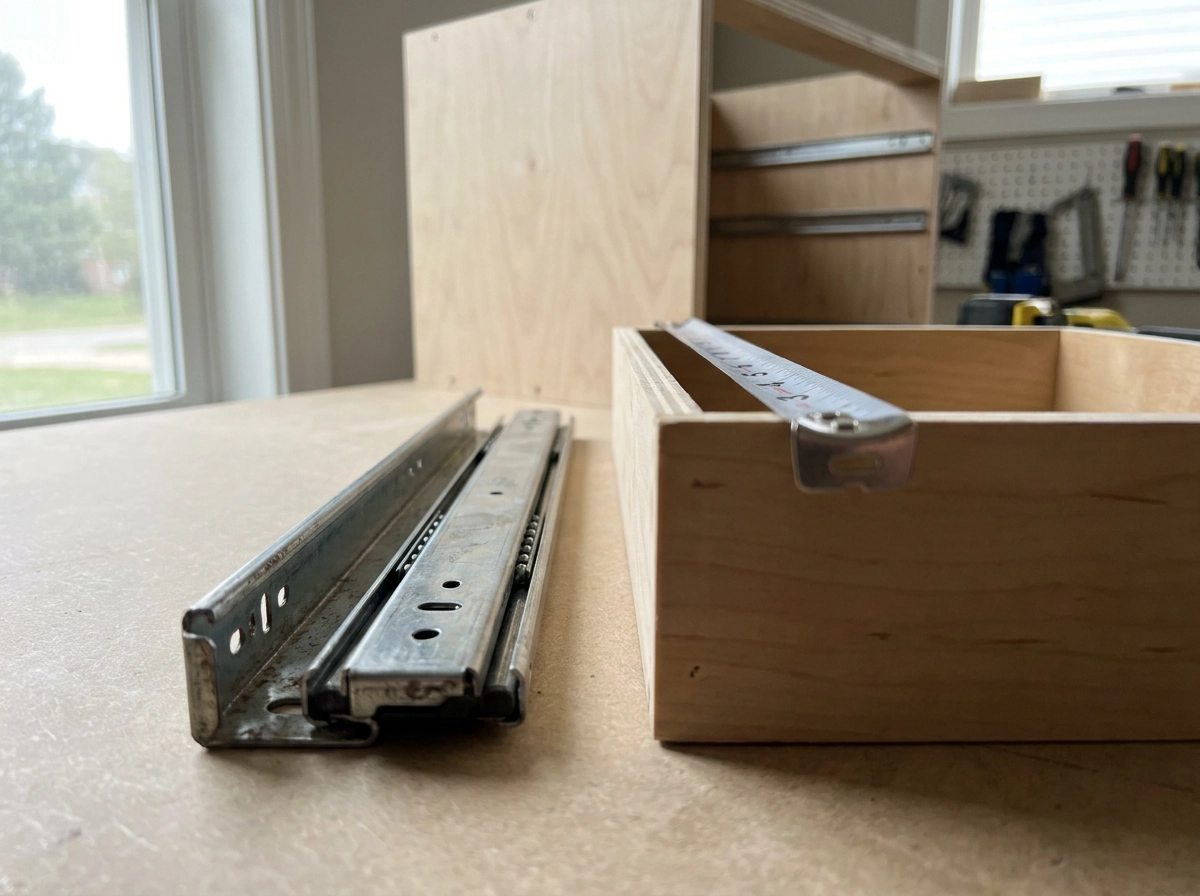
Even correct installation fails when the specification upstream of it is wrong. These five errors account for the majority of heavy-duty runner failures in van and workshop builds.
Slide length matched to cabinet depth, not drawer depth. The slide length must equal the drawer box depth, not the cabinet opening. Fitting a 600 mm slide into a 600 mm deep cabinet leaves no clearance for mounting brackets and drives the drawer box hard against the cabinet rear. Subtract at least 20 mm from the cabinet depth when specifying slide length to allow for hardware clearance.
Selecting on headline load rating alone. A slide advertised at a high load rating may carry a lower rating at longer lengths. Load capacity decreases as slide length increases; always read the full load table for your specific length, not just the maximum figure on the product page.
Confusing pair rating with per-slide rating halves the effective load capacity. If the datasheet does not state “per pair” explicitly, confirm with the supplier before ordering.
Fitting residential under-mount slides in a van. Under-mount runners with plastic carriages are engineered for kitchen cabinet cycles under static, horizontal loads. They have no steel carriage reinforcement and no locking mechanism. In a mobile application, road vibration and lateral cornering forces degrade the plastic components rapidly, and the absence of an in-travel lock means the drawer will open in transit.
Omitting the dynamic load factor for vehicle-mounted use: apply a minimum 1.5x multiplier on top of the static working load before selecting the slide rating.
Choosing the Right Runner from the Trailer Parts Direct Range
Once you have worked through your load calculations and avoided the common specification errors, the next step is matching your requirements to hardware that is actually built for the application.
Trailer Parts Direct stocks heavy-duty drawer slides and drawer runners across the full range of working applications: van racking, 4WD canopy drawers, ute tray toolboxes, workshop cabinets, caravan builds, and site storage boxes. Lengths span compact site box configurations through to full-depth vehicle floor drawers. Finish options span zinc-plated steel for dry indoor environments and stainless steel for coastal, marine, and outdoor exposure conditions.
Load range covers the full spectrum of working applications, from caravan and light storage drawers through to heavy workshop and vehicle drawers rated for the most demanding professional tool loads.
Locking variants include both in-travel locks and open-position locks. In-travel locks secure the drawer closed during transit, which is the non-negotiable requirement for any van racking or mobile storage build. Open-position locks hold the drawer at full extension during use, preventing it from creeping shut under bench vibration or vehicle movement while the user is working. Selecting the correct lock type for the application is as important as selecting the correct load rating.
Stainless steel drawer runner options are particularly relevant for coastal workshops, marine trailers, and exposed outdoor site boxes. Zinc-plated runners in salt-air environments are prone to surface corrosion and eventual seizure without regular maintenance. Stainless steel eliminates that service burden.
As part of the Dunn and Watson Group, Trailer Parts Direct provides application-specific selection support for fabricators and tradies, including load calculation guidance, slide length matching for specific drawer configurations, and mounting hardware advice for both steel and ply substrates.
Conclusion: Specifying Heavy-Duty Drawer Runners That Last
Getting the specification right from the start prevents the two most common failure outcomes: runners that buckle under working load and drawers that jam or fly open in transit.
Applying the load calculation framework from earlier in this guide, add the 1.5x static safety factor for workshop use, and the dynamic multiplier for any mobile application. The 60 kg static van racking load worked through in the calculation section becomes 90 kg or more of dynamic demand once the multiplier is applied; the same 40 kg load in a van demands significantly higher rated capacity once the dynamic multiplier is applied, consult your calculation from the working load section.
Read the rating label carefully. Confirm whether the published figure is a pair rating or a per-slide rating, then verify that the stated capacity applies at full extension for the exact slide length you are ordering. The headline figure and the length-specific, full-extension figure are often different numbers.
Default to full-extension runners for tool storage drawers. Partial-extension slides leave a permanent dead zone at the rear of the drawer, a false economy regardless of the lower upfront cost.
Locking slides remain non-negotiable for mobile applications, in-travel locks for transit, open-position locks for controlled worksite access.
Select your finish based on service environment, not price. Zinc-plated steel performs reliably in a dry indoor workshop. Coastal, outdoor, or high-moisture environments justify stainless steel heavy duty drawer runners from the outset; the longer service life consistently outweighs the higher initial cost.