
Uncategorized
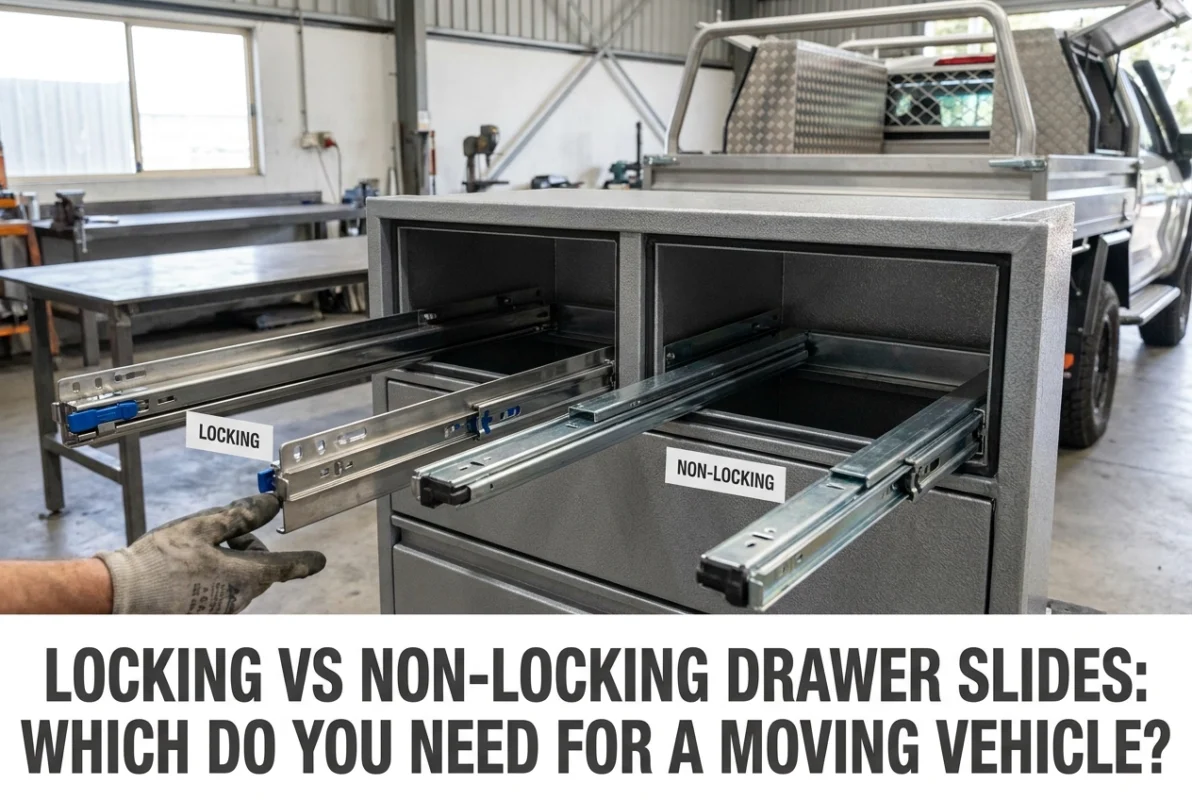
Locking vs Non-Locking Drawer Slides: Which Do You Need for a Moving Vehicle?
Oct
Picture this: you have spent hours building out a canopy drawer system, carefully organising your tools and equipment, only to arrive on site and find every drawer hanging open after a rough stretch of road. It is a frustrating reality that catches plenty of builders off guard, and it highlights a fundamental problem that standard storage content rarely addresses.
Static workshop cabinets and kitchen installations have no reason to account for sudden braking, sharp corners, or corrugated tracks. Vehicle-mounted storage does. That distinction changes every decision you make at the design stage, starting with your choice of locking drawer slides.
This guide breaks down exactly how locking drawer slides work, why residential-rated hardware consistently falls short in toolbox and canopy builds, and how to match the right slide type to your specific application. You will also find a practical speccing checklist, a comparison of lock-in versus lock-out mechanisms, and guidance on material selection for Australian operating conditions. Whether you are fitting out a tradie ute, a service van, or an emergency vehicle, understanding these fundamentals will save you time, money, and a very inconvenient mess on the road.
Why Vehicle Applications Are Different from Static Storage
A drawer fitted in a static workshop cabinet experiences one force: gravity pulling the contents down. Fit the same drawer into a ute canopy or truck toolbox and the load environment changes completely. Sudden braking imposes a sharp longitudinal force. Hard cornering applies lateral load. Corrugated dirt tracks deliver continuous, high-frequency vibration cycles. All three can occur within seconds of each other on a single Australian outback run.
Standard residential drawer slides are designed and tested for static installation. They carry a maximum rated load of around 45 kg under controlled, stationary conditions. Nothing in that specification accounts for dynamic loading, vibration fatigue, or the repeated shock inputs that are routine on corrugated roads between towns in inland Australia.
Australian conditions compound this further. Significant daily temperature swings in inland Australia cause materials to expand and contract repeatedly. Water crossings and dusty tracks introduce moisture and abrasive contamination into bearing assemblies. These stresses accelerate wear on ball-bearing retainers and defeat the soft detents that non-locking slides rely on to stay closed.
Common workarounds from static builds, including bungee cords looped around handles, metal rods dropped across drawer faces, and base-plate wedges, are not engineered solutions. They fail under sustained vibration, they degrade, and they rely on the user remembering to reset them every time.
The safety consequence of getting this wrong is significant. A drawer that opens unexpectedly during hard braking or cornering can displace its contents suddenly. Beyond the immediate hazard, the sudden weight shift places asymmetric load on the slide mounting points, accelerating structural wear over time.
Locking Drawer Slides Explained: Lock-In, Lock-Out, and How They Work
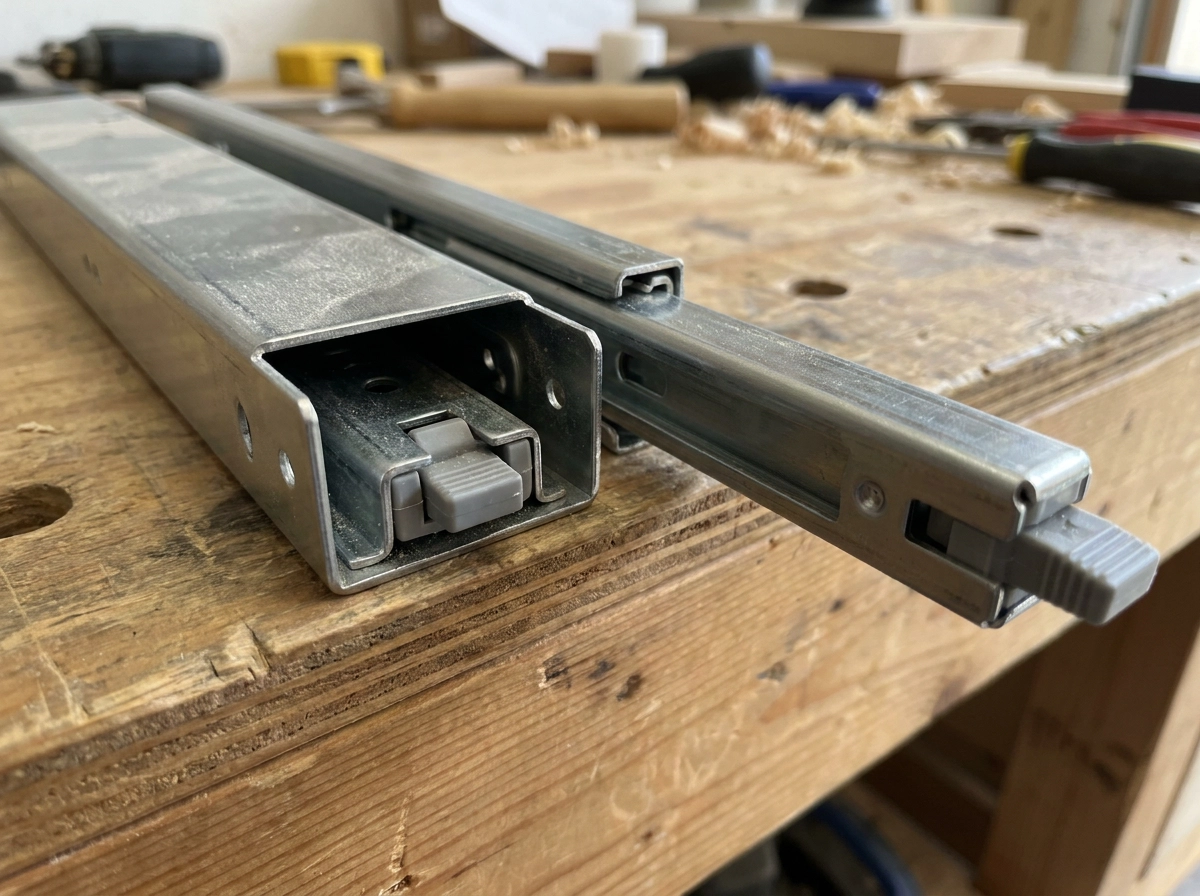
Locking drawer slides address those transit forces through two distinct operating modes built into a single assembly.
Lock-in holds the drawer firmly closed while the vehicle is moving, preventing it from sliding open under braking or cornering loads. Lock-out holds the drawer at full extension during use, so it cannot retract unexpectedly onto the operator’s hands or tools. Both modes are integrated into the same slide body; no secondary latches or separate retention hardware are required.
The most common construction for vehicle applications is a telescopic ball-bearing slide that allows smooth, full-extension travel. The locking mechanism engages at defined positions along that travel, typically at fully closed and fully extended. Release requires a deliberate action, typically lifting or pressing a lever, to disengage the lock. That deliberate action is the key design requirement; a mechanism that releases under sustained vibration provides no real security.
Lockable versus Full Lock-In/Lock-Out
This distinction matters when specifying slides. Some slides are described as “lockable” or as having “locking positions,” but that may mean only that the slide resists forward pull at a single point. For vehicle use, the locking function must hold against lateral and vertical forces as well, not just resist the drawer being pulled open. Always confirm with your supplier which axes the lock engages, and whether both closed and open positions are held positively.
A slide that locks only at full extension is useful for preventing retraction during access, but it offers no transit security. A slide that locks only when closed does the opposite. For toolbox, canopy, or emergency vehicle builds where both access reliability and transit security are priorities, you need confirmed dual-mode locking across all relevant load directions.
Load Capacity: Why Residential-Rated Slides Are Undersized for Toolboxes and Canopies
Locking mechanism selection matters, but it means little if the slide itself is undersized for the load. This is where residential-rated hardware consistently fails in vehicle builds.
A drawer carrying angle grinders, recovery tracks, or a portable compressor can easily exceed residential-rated capacity before you add the drawer box weight.
Heavy-duty and industrial drawer slides are available in ratings that cover the realistic load demands of a ute canopy or truck toolbox.
The more critical issue for vehicle applications is dynamic load. Static ratings measure what a slide can support at rest. In transit, braking forces, cornering loads, and corrugated road impacts all multiply the effective force acting on the slide and its mounting points. A drawer carrying 60kg of hand tools that stops abruptly will momentarily impose forces well above the static weight of those tools.
Speccing slides at or near their rated maximum in a moving vehicle is a reliability risk. The rating becomes the failure threshold rather than a comfortable operating range.
A commonly applied rule of thumb among fabricators is to select slides with a comfortable margin above your maximum expected static load to absorb dynamic forces during transit. That buffer preserves slide longevity across the life of the build.
Which Locking Slide Do You Actually Need? A Build-by-Build Guide
Once you’ve confirmed your load ratings, the next question is which locking mode your build actually requires. The answer depends on the vehicle type and how the drawers are used.
Ute canopy and tray systems need full lock-in and lock-out. Corrugated tracks and off-road terrain generate continuous vibration that will work a non-locking drawer open progressively. In a canopy, an open drawer can foul the door swing or shift contents into the door frame. Both modes are non-negotiable here.
Truck and van toolboxes (on-road fleet use) make lock-in the primary requirement, since these vehicles mostly run sealed roads. Lock-out earns its place on job sites where the vehicle is parked on an incline; without it, a loaded drawer will roll closed on the operator mid-task.
Camper trailers and caravans should use dual-mode locking slides. Towing generates sustained lateral sway and vibration; a locking slide is the appropriate specification for any towed application.
Emergency vehicles represent the most demanding case. Lock-in must secure equipment during response driving; lock-out must hold drawers fully open for immediate access on arrival. Both modes are required, and load ratings should be selected to match the specific equipment being carried.
Static workshop toolboxes and fixed shed storage are the one context where non-locking slides are genuinely appropriate. No transit forces apply, load demands are lower, and the cost saving is a real advantage rather than a compromise.
One additional consideration: if a canopy build incorporates gas struts on the lid, assess drawer slide selection alongside that hardware. Combining gas struts with locking drawer slides gives the entire storage system consistent positive retention, rather than securing the lid while leaving the drawers to shift freely.
Material Selection and Durability for Australian Conditions
Once you’ve matched the locking mechanism type to your build, material selection determines how long that hardware performs in service.
Substrate and construction
Heavy-duty locking slides are manufactured from high-strength cold-rolled steel, which provides the stiffness needed to resist flex under load without the weight penalty of thicker mild steel. That matters in any vehicle application where payload and unsprung mass are genuine concerns.
Corrosion protection by environment
Zinc-plated and electroplated finishes are the standard choice for general inland Australian applications.
Coastal, tropical, and marine environments require a higher specification. Salt air accelerates corrosion on zinc-plated steel, which can compromise the precision components of the locking mechanism over time. Stainless steel drawer slides are the correct choice here. The cost premium is justified by eliminating rust-related binding, which can render a locking mechanism entirely inoperable.
Wash-down applications, including trade vehicles regularly hosed out, should also be treated as marine-grade environments.
Thermal cycling and bearing clearance
Inland Australia and the NT impose significant daily temperature swings. Where aluminium drawer boxes are paired with steel slides, material expansion differences under temperature cycling can cause binding. Specify slides with quality bearing retainers and adequate clearance tolerances to accommodate differential movement.
Vibration and wear
Corrugated roads apply sustained, high-frequency loading to every component in the slide assembly. The bearing retainers and locking components experience the greatest cumulative stress under sustained vibration. When evaluating slide quality for corrugated-road use, ask suppliers for field-proven applications rather than relying solely on static load ratings.
When Non-Locking Drawer Slides Are the Right Call
Material durability narrows the slide selection to the right product family. The next question is whether locking functionality belongs in the spec at all.
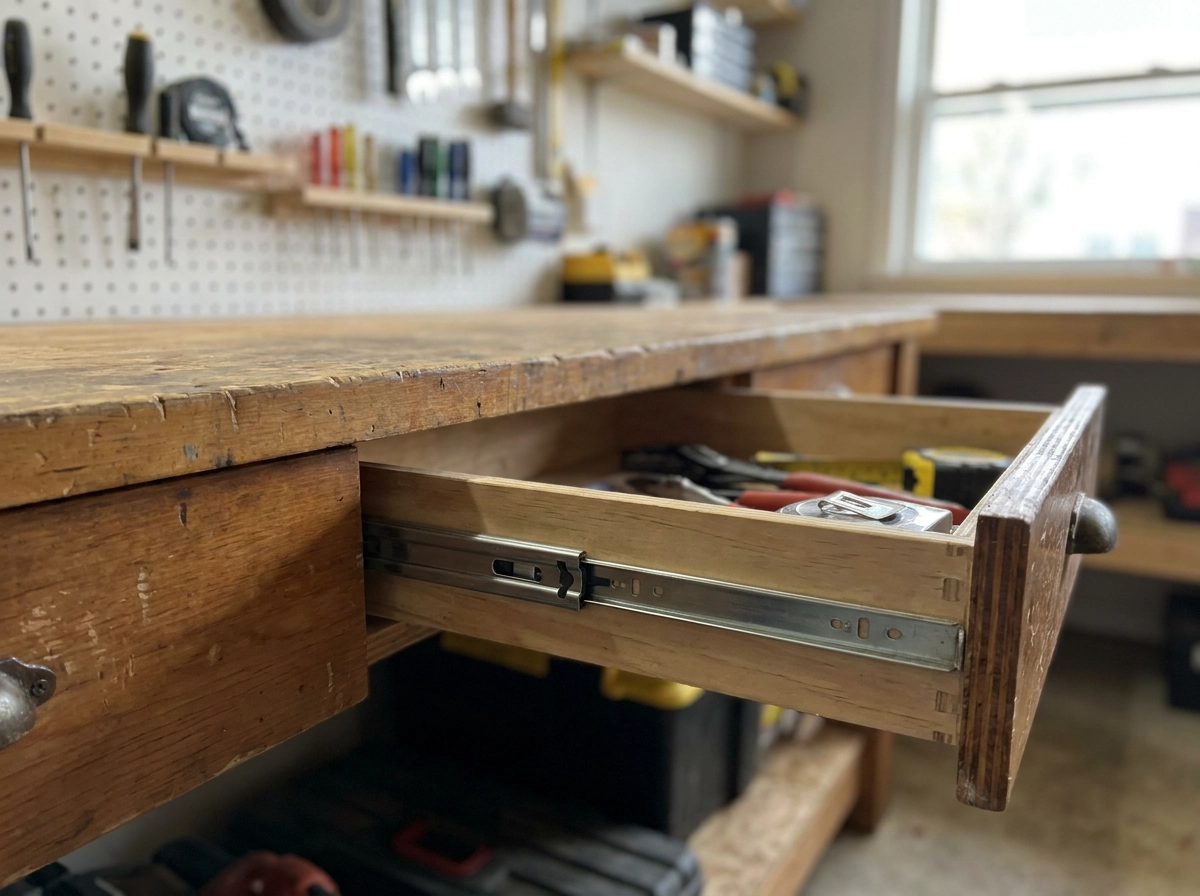
For fixed installations, it does not. Non-locking drawer slides are the correct choice for workshop benches, shed storage cabinets, and garage tool storage. When the installation never moves, the relevant selection criteria are load rating, extension length, and ease of mounting. Paying for an integrated locking mechanism in that context adds cost without adding function.
For static DIY builds on a tight budget, a practical middle path exists: non-locking slides combined with a quality lock or latch fitted to the drawer face. The drawer face hardware handles retention; the slide handles travel and load. This works reliably, provided the installation stays fixed.
Where this logic fails is in any mobile application. Non-locking slides fitted to a vehicle to save money tend to produce a different set of costs over time: worn or broken drawer faces from repeated impact during transit, degraded mounting points from sustained vibration, and the ongoing labour of managing bungee cords or other manual workarounds that were never adequate substitutes for an integrated mechanism.
How to Spec Locking Drawer Slides for Your Build: A Practical Checklist
Once you’ve confirmed a locking slide is the right call, translating that decision into an accurate specification takes six steps.
1. Measure the cavity, not the drawer box. Slide length should match the internal depth of the toolbox or canopy cavity. Check the extended length against any obstructions; canopy door frames and tray edges are common interference points that an undersized extension will foul.
2. Calculate load, then apply a transit multiplier. Add the weight of the drawer box to the maximum weight of its contents. Select slides with a comfortable margin above that combined figure to account for the dynamic forces that vehicle use imposes beyond static weight.
3. Verify both lock-in and lock-out are present. Not every slide marketed as a locking drawer slide provides both functions. Confirm both modes with the supplier before ordering, particularly for canopy and toolbox builds where you need both.
4. Match the material to your environment. Zinc-plated cold-rolled steel suits inland and general Australian conditions. Coastal, marine, or wash-down environments require stainless steel drawer slides, as covered in the material selection section above.
5. Check mounting hole patterns and side clearances. A slide that cannot mount flush to the cabinet wall loses load capacity and can bind under load. Confirm the hole pattern suits your construction before fabrication proceeds.
6. Coordinate with any gas struts in the same build. If the canopy lid or access panels use gas struts, select the drawer slides and gas strut specifications together. A consistent retention system across all components avoids a situation where the drawers are secured but a poorly specced lid strut allows uncontrolled movement.
Key Takeaways: Locking Slides Are Not Optional in a Moving Vehicle
With your spec checklist complete, these are the decisions that matter most before you order.
Non-locking slides belong in static storage only. Any drawer fitted inside a moving vehicle requires an integrated locking mechanism. Bungee cords, metal rods, and wedges are not engineering solutions; they are workarounds that fail under braking, cornering, and corrugated road vibration.
Lock-in and lock-out are both required for most vehicle builds. The locking modes section explains how each functions and which builds require both.
Load ratings carry more weight in vehicle applications than static ones. Select slides with a margin above your maximum expected static load; the load capacity section covers the full spec logic.
Match material to environment. The material selection section sets out which finish suits each Australian operating condition.
Trailer Parts Direct stocks heavy-duty locking drawer slides suited to ute canopies, toolboxes, caravans, and camper trailers. If you need help confirming the right slide for your build, the team can assist with spec selection based on your exact application, load requirements, and operating environment.